
If you're staring at a floorplan, a lease deadline, and a pile of old monitors, you're not dealing with junk. You're managing assets, liability, and time pressure. That distinction is what separates a smooth office exit from a project that burns budget, creates security gaps, and leaves your team arguing over who approved what.
Office cleanout services work best when they're treated like a controlled decommissioning project. Furniture has to move. Data-bearing devices have to be identified. Building access has to be coordinated. Finance needs a disposition trail. IT needs proof that nothing left the site unsecured. Facilities needs the space returned in acceptable condition.
That mix of requirements is why experienced teams don't start with a truck. They start with a plan.
The Strategic Blueprint for Your Office Cleanout
Most first-time cleanouts fail in the same way. A manager books labor before defining scope, IT assumes Facilities is tracking equipment, and Finance learns too late that disposal costs don't match the original estimate. A planned approach avoids that. Professional office cleanouts deliver 40 to 60% lower long-term costs and 90% reduced liability exposure, while unplanned cleanouts overrun budgets by an average of 35% according to this large-scale cleanout planning analysis.
Start with business objectives
A cleanout tied to a lease exit isn't the same as a cleanout tied to a merger, renovation, or data center shutdown. The objective determines the workflow.
Use a simple scope framework:
- Operational assets: Equipment the business is keeping, relocating, or redeploying.
- Disposition assets: Laptops, servers, printers, phones, and peripherals that need resale, recycling, or destruction.
- Facilities items: Desks, shelving, seating, breakroom equipment, and fixtures.
- Residual waste: Packaging, broken furniture, mixed debris, and nonrecoverable materials.
If you're also planning a move, it helps to review how specialized office relocation services handle sequencing, because relocation and decommissioning often overlap but shouldn't share the same assumptions.
Practical rule: If an item plugs in, stores data, mounts to a wall, or appears on a fixed asset register, don't let anyone classify it as simple trash.
Build an internal decision team
Office cleanout services run better when one person owns the calendar and three functions own decisions.
A workable model looks like this:
| Role | Owns | Why it matters |
|---|---|---|
| IT | Data devices, retention rules, wipe or shred decisions | Prevents unsecured disposition |
| Facilities | Access, elevators, loading dock, landlord requirements | Prevents day-of delays |
| Finance or Procurement | Asset approval, resale review, final reporting | Prevents disputes over write-offs |
That team doesn't need a weekly steering committee. It does need a single scope document, a disposition policy, and a signoff path before any removal starts.
A lot of clients skip vendor review until they're already under deadline. That's risky. A practical place to start is this vendor due diligence checklist, especially if you're comparing an ITAD provider, a mover, and a general junk hauler.
Sequence the work before people arrive
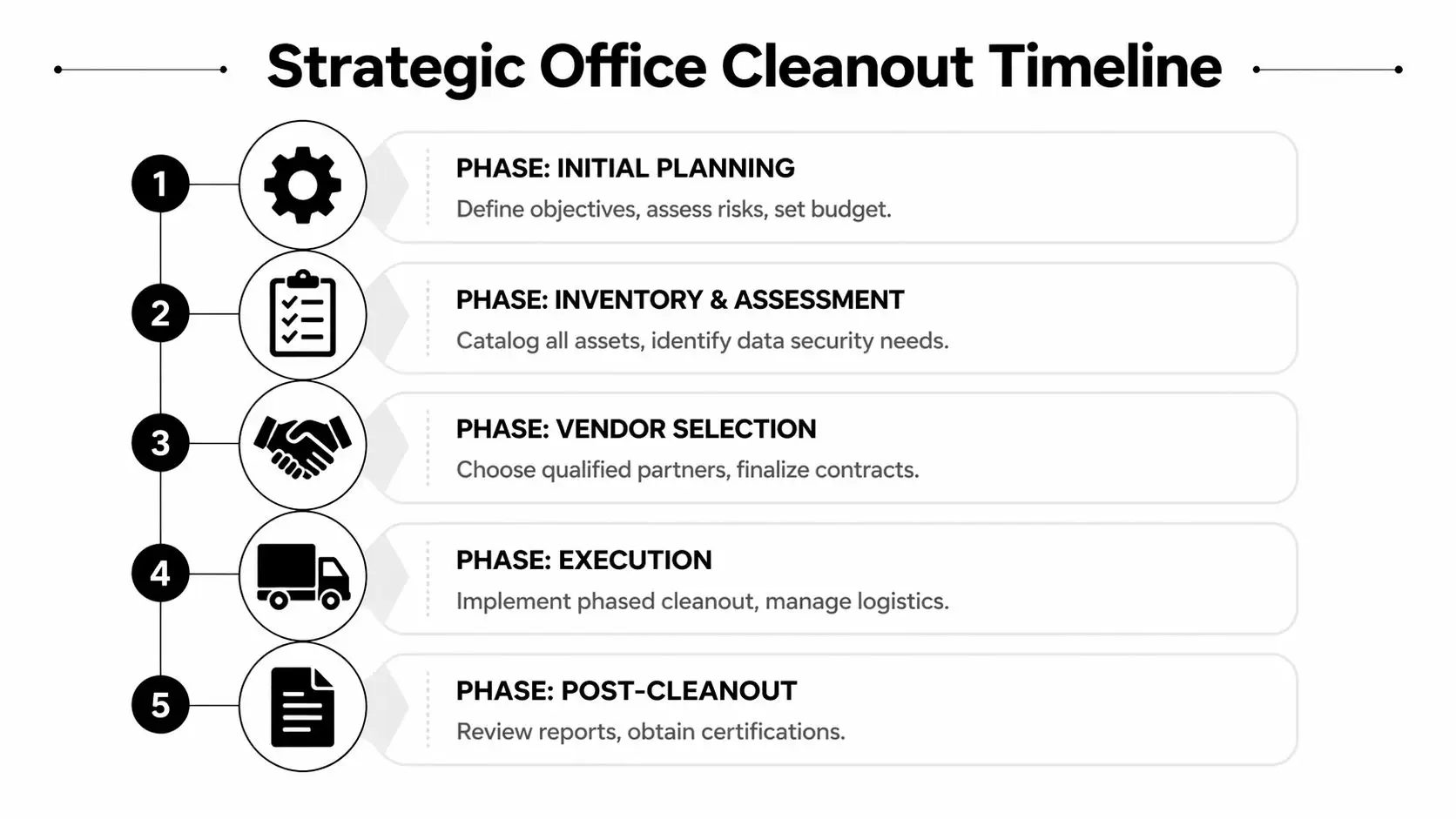
The cleanest projects follow a phased pattern. Remove low-risk, nonessential items first. Schedule high-risk IT assets during a controlled pickup window. Leave final sweep and landlord-facing punch items to the end.
A solid sequence usually includes:
- Scope freeze after stakeholder approval.
- Inventory confirmation with item-level categories.
- Vendor validation for security, logistics, and reporting.
- Phased pickup by floor, room, or department.
- Closeout package with certificates and final disposition records.
The project usually feels complicated because too many decisions are being made on pickup day. Good planning moves those decisions earlier.
When clients ask what works best, the answer is consistency. Clear approvals beat improvisation. Tagged assets beat handwritten lists. A documented process beats good intentions every time.
A Comprehensive Guide to Asset Inventory
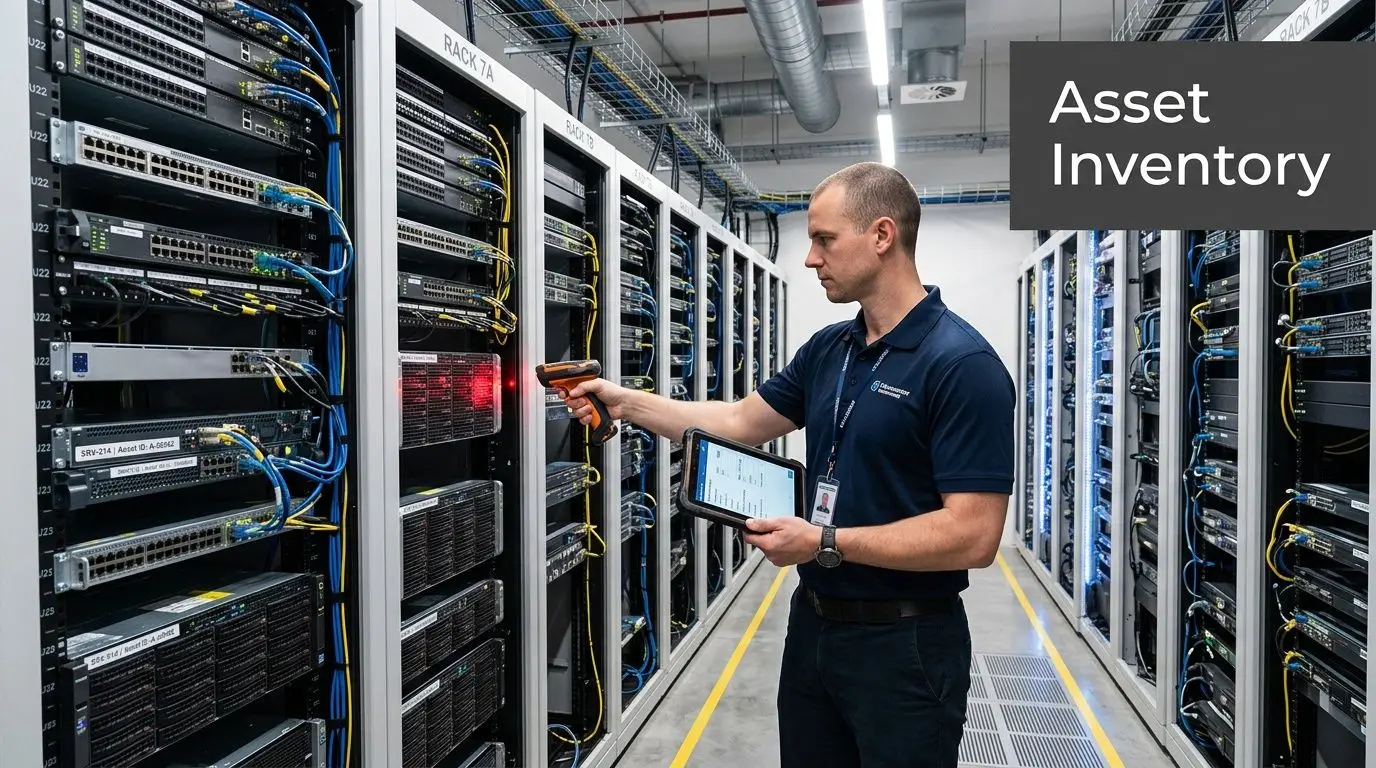
The inventory is the control point for the whole project. If the list is wrong, the quote is wrong, the chain of custody is weak, and somebody will discover missing equipment after the truck is gone.
What to capture on every line item
For a small office, a spreadsheet works. For a larger site, barcode scans or asset tags save time and reduce confusion. The format matters less than the fields.
Include these columns:
- Asset category such as laptop, monitor, server, desk, chair, printer, file cabinet
- Manufacturer and model
- Serial number or asset tag
- Location such as floor, room, rack, or workstation
- Disposition path such as keep, move, resell, recycle, destroy
- Data-bearing status yes or no
- Condition notes
- Approval owner
The reason for this detail is simple. Generic office cleanout services often price around volume. ITAD-focused work prices around identification, handling requirements, and reporting.
Separate data-bearing devices first
Don't inventory the office as one blob of property. Break it apart by risk.
A practical segmentation method:
| Group | Examples | Main decision |
|---|---|---|
| Data-bearing IT | Laptops, desktops, servers, NAS devices, copiers | Wipe, shred, redeploy, resell |
| Non-data electronics | Monitors, docks, cables, phones without storage | Recycle or redeploy |
| Furniture and fixtures | Desks, cubicles, seating, shelving | Move, liquidate, remove |
| Paper and media | File boxes, backup tapes, documents | Retain or destroy |
The important mistake to avoid is burying IT equipment inside a furniture count. A rolling chair and a storage array don't belong in the same handling stream.
Use disposition codes, not comments
I've seen inventories fail because every department writes its own notes. One person writes "remove." Another writes "dispose." Another writes "old." None of that tells the pickup crew what to do.
Use short codes instead:
- K for keep
- RDP for redeploy
- RV for resale/value recovery
- REC for recycle
- DD for data destruction required
That gives your office cleanout services provider a usable instruction set. It also gives Finance and IT a cleaner review process.
If a device doesn't have a documented disposition code, it shouldn't leave the building.
For organizations with frequent refresh cycles, formal IT asset lifecycle management becomes particularly useful. The office cleanout becomes the final stage of a process you've already documented, rather than a scramble to identify what the business owns.
A mid-sized office example
Take a regional office with shared workstations, a small server room, conference spaces, and storage closets. The visible items are easy to count. The hidden risk sits in under-desk PCs, retired laptops in cabinets, printers in copy rooms, and rack gear nobody has touched in years.
The strongest inventories are built room by room, then reconciled against any available asset register. When the floor walk reveals hardware that's missing from records, flag it immediately. That gap often signals older devices that need extra scrutiny before removal.
Ensuring Data Security and Regulatory Compliance
Office cleanout services cease to be merely a facilities task and instead become a compliance project. A desk can be removed by almost anyone. A retired server, firewall, copier hard drive, or storage appliance can't.
Up to 80% of office electronics retain residual data if not properly wiped. Professional destruction through NSA-approved shredding or certified wiping aligned to NIST 800-88 guidelines matters because non-compliance fines can exceed $10,000, and breach costs can run into the millions, as outlined in this office cleanout and junk removal compliance guide.
Factory reset is not a disposition policy
One of the most expensive assumptions in a cleanout is that powering on a device, deleting files, or performing a basic reset solves the data problem. It doesn't create a defensible record, and it doesn't prove what happened to the storage media.
For business environments, the decision is usually one of these:
- Certified data wiping for devices with remarketing or redeployment value
- Physical shredding for failed drives, highly sensitive media, or equipment leaving restricted environments
- Documented retention hold when Legal or Compliance hasn't released the asset
The method should match the asset, the data class, and the regulatory requirement.
Chain of custody is the real control
Clients often focus on the destruction event. The more important question is what happened before that event. Who identified the device. Who packed it. Who signed for it. Whether it was serialized. Whether transport was documented. Whether the final certificate matches the item list.
That chain is what turns disposal into liability transfer.
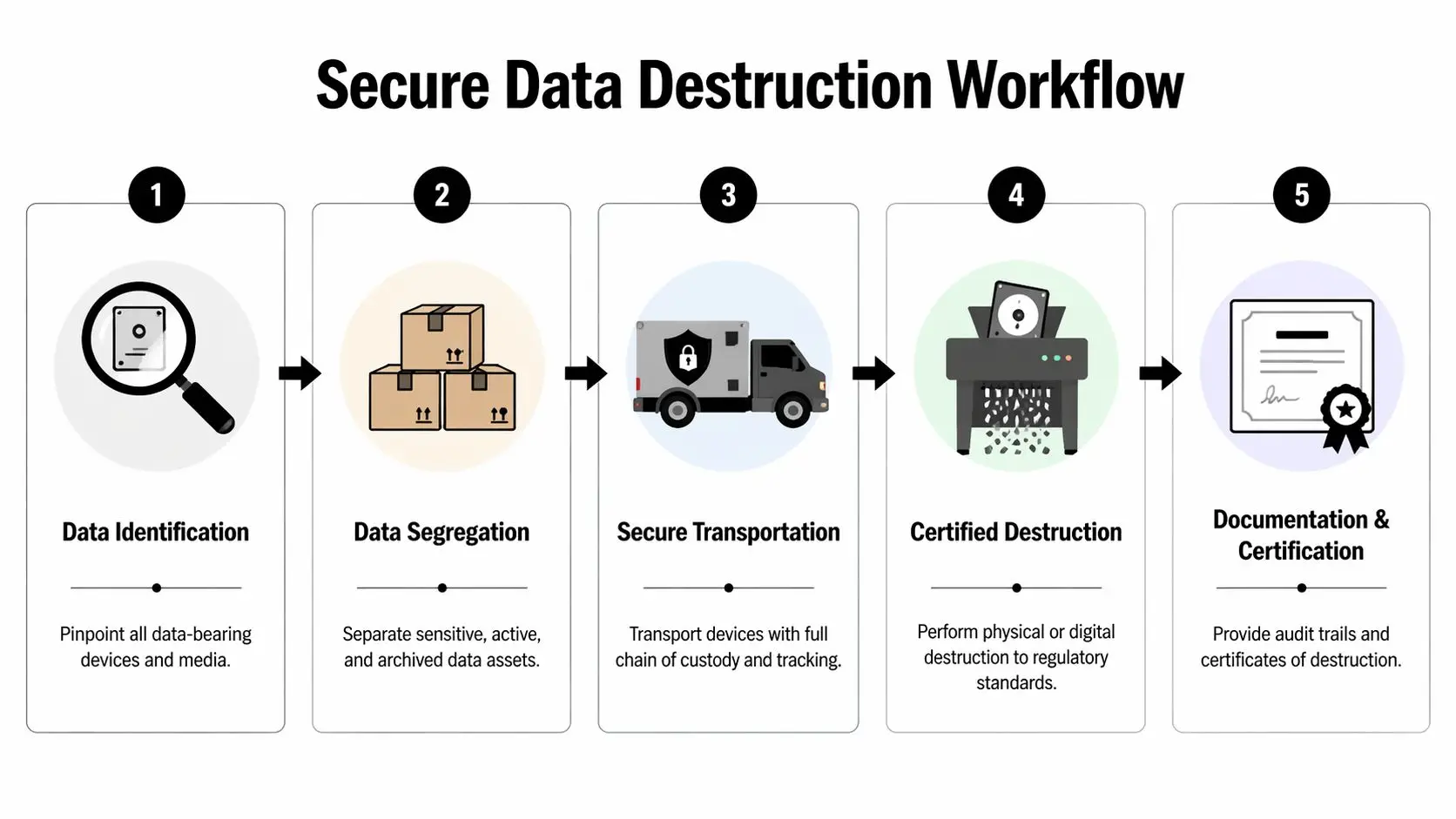
A defensible process usually includes:
- Identification of every data-bearing device during inventory
- Segregation from non-IT material on-site
- Serialized tracking or equivalent documented logging
- Secure transport with restricted handling
- Certificates for destruction and recycling tied back to the asset record
Security failures during cleanouts usually start in the handoff, not in the shredder.
Healthcare, finance, education, and government teams already understand this instinctively. Their issue isn't whether secure destruction is needed. It's whether the vendor's paperwork will satisfy an auditor months later.
What to ask a provider before pickup
Many junk-style providers fall short. They can remove equipment, but they often don't explain how they handle data-bearing devices, whether they issue certificates, or how they document custody.
Ask direct questions:
- Will you provide itemized or batch-linked documentation for the devices collected?
- Do you offer on-site and off-site hard drive shredding?
- Can you perform certified wiping when equipment has resale value?
- How do you separate data-bearing equipment from general e-waste at pickup?
- What certificates will we receive after processing?
- How is the handoff documented from our staff to your transport team?
One option in this category is NIST SP 800-88 data sanitization guidance from Beyond Surplus, which outlines the sanitization standard many IT teams use when evaluating end-of-life media handling.
Match destruction to business reality
Not every environment needs the same method. A remote sales office with standard laptops may prioritize certified wiping and resale. A clinic, bank branch, or legal office may decide that physical destruction is simpler and easier to defend. A data center de-installation often uses both, depending on drive health, equipment value, and customer requirements.
What doesn't work is sending mixed pallets of electronics to a general hauler and hoping the downstream recycler handles the data correctly. Once devices leave your control without documentation, you're relying on trust where you should be relying on records.
If your audit file can't show what left the site, how it was handled, and how it was destroyed or sanitized, the project isn't complete.
Executing the Cleanout with Precision Logistics
On cleanout day, the difference between a calm project and a chaotic one shows up fast. The freight elevator slot is narrow. Building management wants floor protection. The loading dock has competing tenants. Someone discovers an extra printer closet. None of that is unusual. Good logistics absorb it.
What a well-run pickup looks like
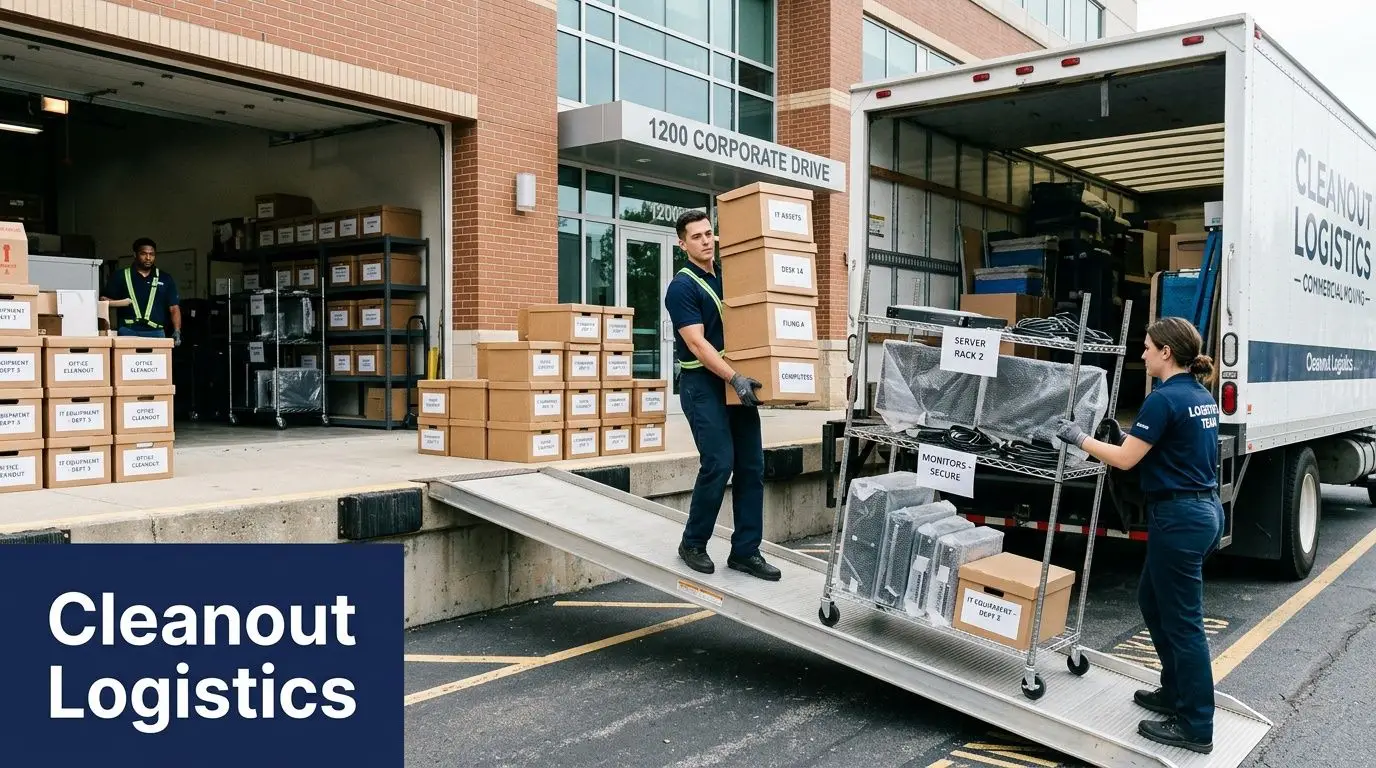
The crew starts with a walkthrough against the approved inventory. Tagged items are verified. Data-bearing devices are separated from furniture and loose recycling. Pickup paths are confirmed with site contacts before the first cart moves.
Then the work gets phased:
- Early pass: Boxed electronics, stored equipment, nonessential furniture
- Controlled pass: Network gear, servers, printers, and other approved IT assets
- Final pass: Remaining loose materials, signage, and sweep-out items
That sequencing reduces confusion and keeps the high-risk stream visible.
Why quotes go wrong
Pricing surprises usually come from poor scoping, not bad math. Average office cleanout projects range from $150 to $1,200, and specific items such as printers and monitors can add $100 to $300, according to this commercial cleaning and office cleanout market overview.
That doesn't mean every project fits a simple rate card. It means detailed inventory matters. A site with a handful of desks isn't priced like a site with rack equipment, battery backups, copier hard drives, and restricted access windows.
Coordinate the building, not just the truck
Office cleanout services live or die on building coordination. Before execution, confirm:
- Access windows: Freight elevator and dock reservations
- Protection rules: Pads, masonite, or hallway protection if required
- Certificates and insurance: Whatever the property manager requires from vendors
- Exit condition: What must stay, what must go, and how final sweep is judged
If your project includes renovation handoff after equipment removal, it's useful to compare how specialized construction clean up services handle debris sequencing and site readiness. The lesson carries over. Trades, movers, recyclers, and facilities teams need separate lanes of work.
For IT-heavy projects, item-level removal planning matters as much as labor. That's why many teams use an IT asset removal process instead of folding everything into a generic move-out scope.
A cleanout crew shouldn't be deciding in the hallway whether a pallet holds resale inventory, scrap, or devices that need destruction.
Unlocking Hidden Value and Environmental Benefits
A cleanout can drain budget, or it can return value. The result depends on whether you treat older equipment as waste or as a mix of resale assets, recyclable commodities, and documented sustainability outputs.
Where the financial return comes from
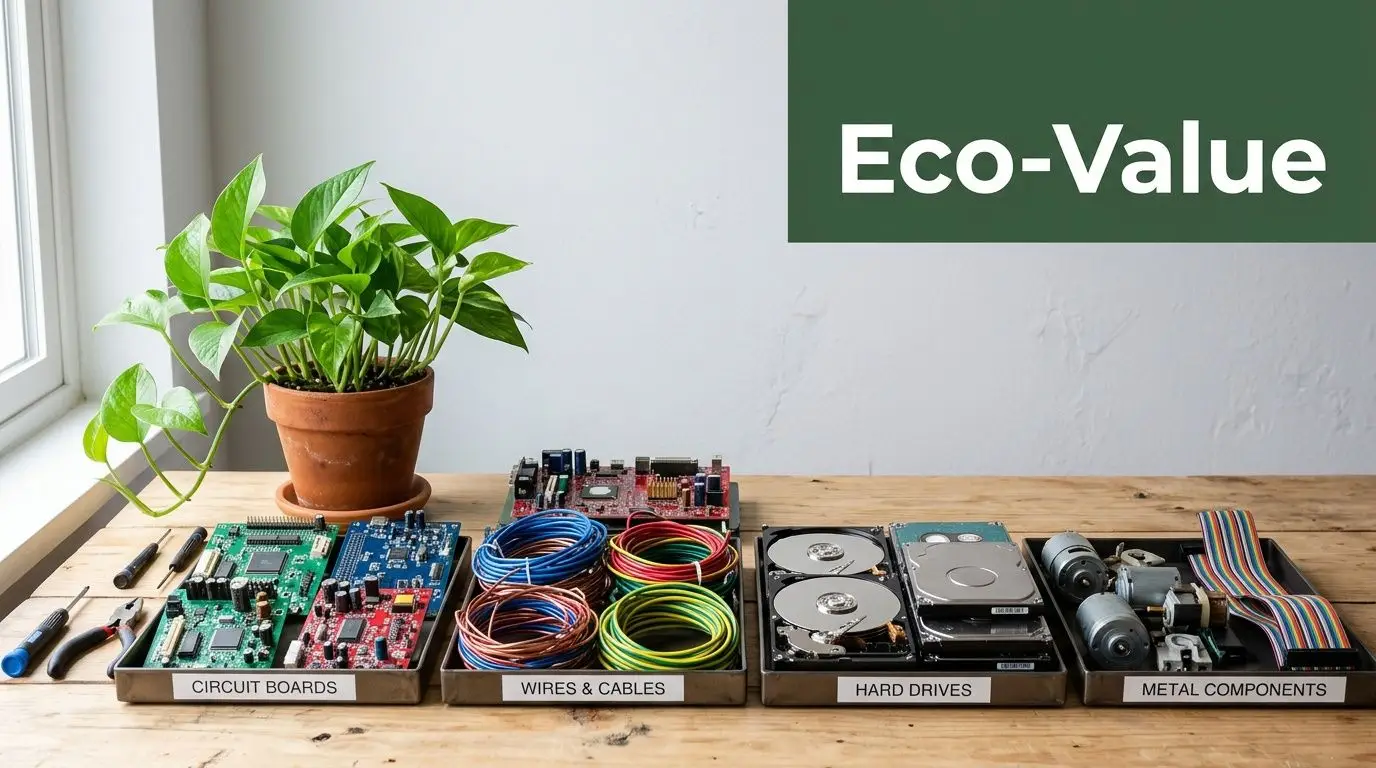
Not every retired device has market value, but enough of them often do to change the economics of a project. According to the planning data cited earlier, scrap metal from servers and other electronics can be worth $200 to $500 per ton, and IT buyback programs can offset up to 50% of total service costs for assets with remarketing potential.
The practical takeaway is straightforward. Newer laptops, business-class desktops, network switches, and some server gear may belong in a resale stream. Damaged, obsolete, or incomplete hardware usually belongs in a certified recycling stream.
A simple value-recovery split looks like this:
| Asset type | Likely path | Business impact |
|---|---|---|
| Recent laptops and desktops | Buyback or redeployment | Offsets project cost |
| Servers and network gear | Parts recovery, resale, or scrap | Preserves residual value |
| Broken peripherals | Recycling | Reduces uncontrolled disposal risk |
| Mixed e-waste | Commodity recovery | Supports reporting and diversion goals |
Environmental reporting matters more than disposal language
Clients often say they want electronics "disposed of properly." That's too vague for ESG reporting or procurement review. What they need is documented reuse, recycling, and destruction activity that can be reconciled after the fact.
Useful closeout reporting often includes:
- Item counts by disposition stream
- Certificates of recycling and destruction
- Summary of assets remarketed or recovered
- Documentation suitable for sustainability records
asset recovery services in Georgia and similar programs become more than a resale exercise. They give finance, procurement, and sustainability teams a cleaner end-of-life record.
The best environmental outcome usually isn't hauling everything away fast. It's separating what can be reused, remarketed, recycled, and securely destroyed before anything leaves the site.
The trade-off is time and discipline. Quick bulk removal feels efficient. Structured value recovery is usually smarter.
Your Essential Office Cleanout Checklist
Keep this list next to your lease schedule, project tracker, or move plan. It catches the items that are easiest to miss under deadline pressure.
Planning and scoping
- Define the trigger: Closure, relocation, renovation, consolidation, or decommissioning
- Assign owners: One lead each from IT, Facilities, and Finance or Procurement
- Set disposition rules: Decide what gets moved, resold, recycled, or destroyed
- Review site conditions: Confirm landlord requirements, dock access, and timing restrictions
Inventory and assessment
- Build the master list: Record asset type, location, serial, and condition
- Flag data-bearing devices: Keep them out of general removal streams
- Apply disposition codes: Use consistent labels instead of freeform notes
- Validate the unknowns: Storage rooms and server closets usually hold the surprises
Vendor selection and security
- Check documentation: Chain of custody, certificates, and downstream handling
- Match method to risk: Wiping for value recovery, shredding for sensitive media
- Confirm insurance and building compliance: Don't leave this for pickup day
- Use a planning aid: A practical office declutter checklist can help teams organize room-by-room prep before the vendor arrives
Logistics and execution
- Reserve access windows: Elevators, dock, and staging area
- Separate streams on-site: Furniture, recycling, and data-bearing devices
- Walk the site before loading: Reconcile inventory and exceptions
- Capture signoff: Make sure the handoff is documented
Post-cleanout and reporting
- Collect certificates: Recycling and data destruction records
- Reconcile removed assets: Match paperwork to the approved inventory
- Close finance items: Note recovered value, write-offs, and final charges
- Archive the project file: Keep it ready for audits, lease questions, or internal review
If you're planning an office exit, relocation, or technology refresh, Beyond Surplus can help coordinate secure IT asset disposal, data destruction, electronics recycling, and asset recovery with documentation built for business use. Contact the team to scope your office cleanout services project and align logistics, compliance, and value recovery before pickup day.