
You usually hear about the office move after the lease is signed and the date is already on the calendar. Facilities wants the floor plan. HR wants the seating chart. Finance wants the move done without waste. IT gets the harder brief. Keep the business running, protect the data, account for every asset, and don’t let a weekend move become a security incident on Monday.
That’s why the importance of office relocation movers is often underestimated. For an enterprise environment, this isn’t a furniture project with some cables mixed in. It’s an infrastructure cutover, a chain-of-custody exercise, and often an IT asset disposition event happening at the same time.
The Modern Office Move A High-Stakes IT Project
Most failed moves don’t fail because a desk got scratched. They fail because no one treated the relocation like a controlled change to production systems. A server gets powered down out of sequence. Network gear arrives before the rack layout is ready. Retired laptops sit in an unsecured staging area. Those are management failures, not moving accidents.
The scale of the market shows why this keeps happening. The global office relocation services market was valued at US$ 10.6 billion in 2022 and is projected to reach US$ 14.6 billion by 2032, with North America holding 42% market share, according to Fact.MR’s office relocation services market analysis. Large numbers don’t make moves easier. They show how often companies are exposed to the same operational risks.
What changes when IT leads the move
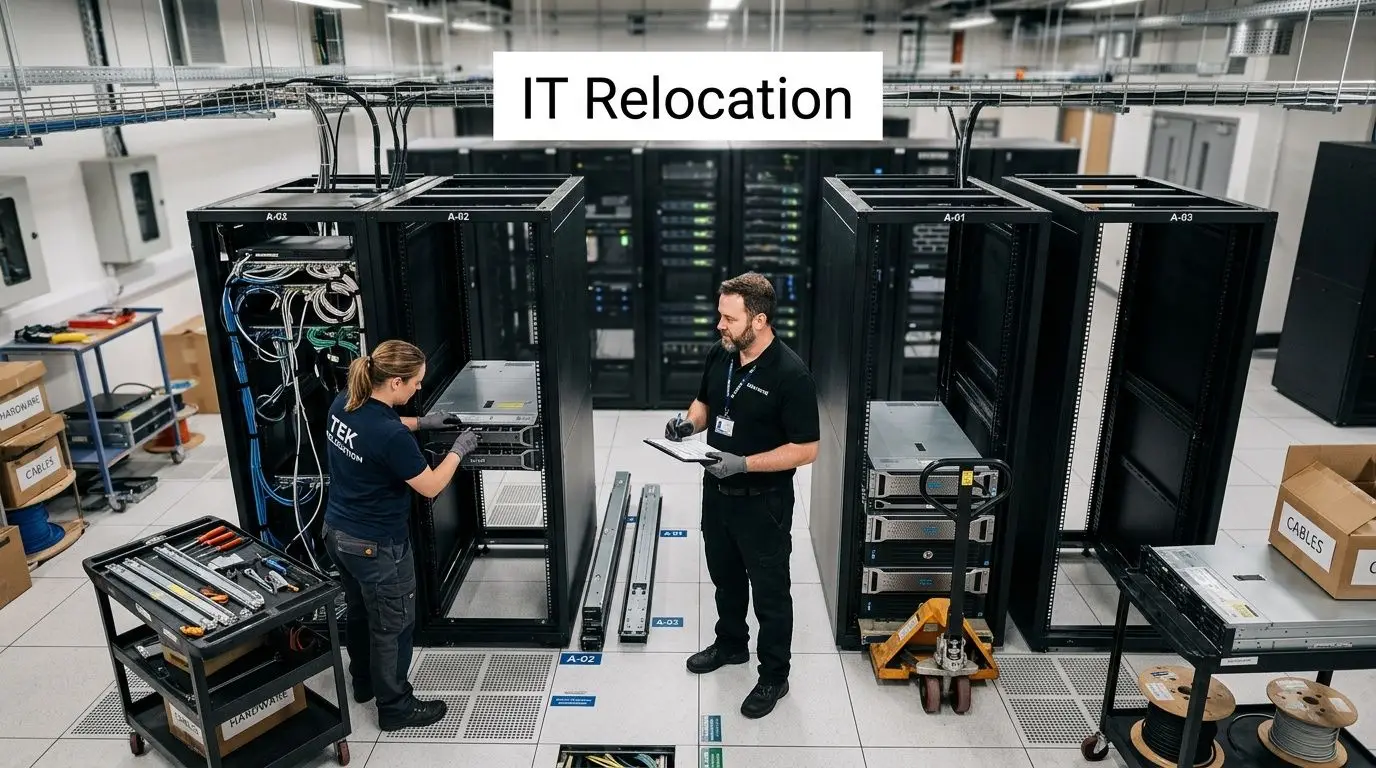
When IT has a real leadership role, the move plan changes fast. The discussion shifts from trucks and packing supplies to dependency mapping, backup validation, access control, disposal workflows, and recovery order at the new site.
That’s the right lens because every asset falls into one of three paths:
- Move it: Production equipment, active endpoints, and licensed devices with a defined destination.
- Store it: Hardware that still has business value but doesn’t belong in the new footprint yet.
- Dispose of it securely: End-of-life assets, failed drives, obsolete network gear, and anything that creates storage, audit, or data exposure risk.
Practical rule: If an asset doesn’t have a named owner, a destination, and a disposition status, it shouldn’t enter move week.
What office relocation movers often miss
Many commercial movers are competent at logistics. Fewer are competent at handling regulated data, serialized electronics, and decommissioned hardware. An office chair can be blanket-wrapped and stacked. A storage array, firewall, or executive laptop cannot be treated the same way.
That distinction drives the rest of the project. The best moves aren’t the ones that look smooth from the lobby. They’re the ones where every handoff is documented, every system is recovered in sequence, and every retired device leaves the chain of custody the right way.
Developing Your Strategic Relocation Blueprint
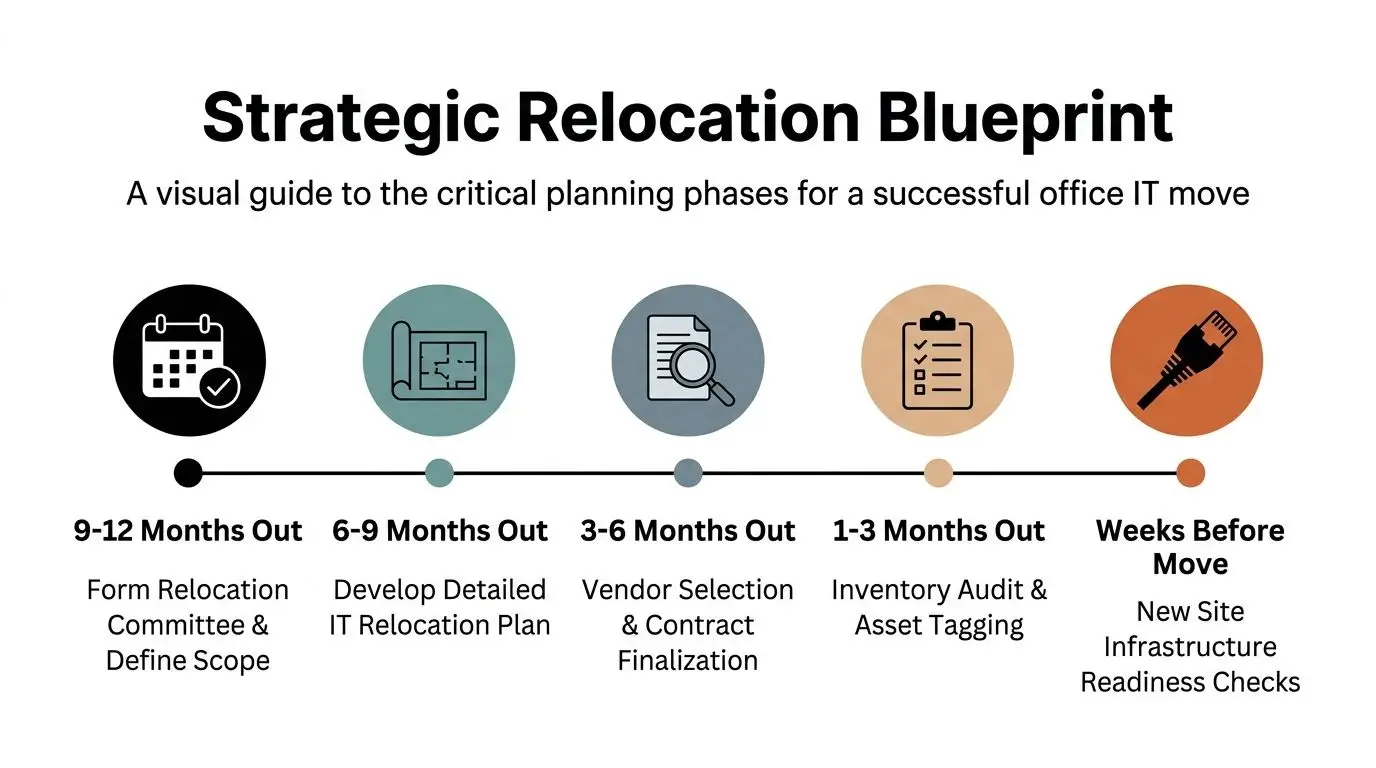
A clean move starts months before the first crate shows up. If you wait for packing day to figure out what’s moving, what’s being retired, and who approves exceptions, you’re already behind.
The most reliable framework is phased. JK Moving’s commercial relocation guidance recommends Phase 1 Planning (2-3 months), Phase 2 Preparation (1-2 months), Phase 3 Execution (1-2 weeks), and Phase 4 Post-Move (2-4 weeks). That same source warns budgets can run 20-30% over when project management is weak. In practice, that overruns category usually hides in rushed labor, duplicate transport, emergency cabling, storage, and avoidable IT rework.
Build the right relocation committee
Facilities should not own this alone. Neither should IT. The workable model is a cross-functional committee with one accountable relocation lead and clear decision rights.
Include these roles early:
- IT leadership: Owns infrastructure sequencing, endpoint strategy, backup validation, and cutover risk.
- Facilities: Handles site access, loading dock windows, elevator reservations, and floor readiness.
- HR and communications: Manages employee notices, expectations, and day-one support.
- Procurement or finance: Reviews contracts, insurance language, and change-order controls.
- Security or compliance: Reviews disposal handling, restricted areas, and documentation requirements.
If your team is redesigning workstations or reducing footprint at the same time, Slone Brothers' office space guide is a useful planning reference for layout and workspace decisions before equipment placement is finalized.
Decide what the move is supposed to accomplish
Weak move plans focus on transport. Strong move plans use the relocation to fix underlying problems.
Common examples:
- Retire obsolete equipment before it reaches the new site. Don’t pay to move junk.
- Consolidate server and storage footprints. Fewer devices mean fewer failure points.
- Standardize workstations and peripherals. Moves expose years of unmanaged exceptions.
- Clean up records and ownership. If no one knows who owns a device now, they still won’t know after the move.
This is also the point where IT asset disposition should be built into the master plan, not treated as a clean-up step. A lifecycle approach like IT asset lifecycle management keeps move, reuse, redeploy, and destruction decisions tied to the same inventory record.
A relocation plan without an asset disposition plan usually creates a storage problem first and a compliance problem later.
Set the blueprint before scheduling labor
A move date is not a strategy. Before you lock vendors and loading windows, complete these planning actions:
Define site readiness
New office space should have rack locations, power, circuit validation, carrier handoffs, access controls, and receiving procedures confirmed before any production hardware ships.
Establish asset classes
Separate furniture from IT. Then separate active IT from end-of-life IT. Within active IT, distinguish business-critical systems from general office endpoints.
Create approval paths
Who can decide that a device is scrapped instead of moved. Who approves emergency rentals. Who signs off on media destruction. Those choices can’t wait for move weekend.
Build a rollback posture
Not every move gets a full rollback. Every move needs a recovery plan. Know which systems must come back first and what temporary workarounds are acceptable if one workstream slips.
The planning artifacts that actually matter
A practical blueprint usually includes:
- A master asset register with serials, owners, departments, and disposition status
- A move matrix showing asset, source location, destination, and required handling
- A dependency list for networks, telecom, servers, printers, AV, badge systems, and shared devices
- A communications calendar for internal teams, vendors, landlords, and building management
- A documentation pack for insurance, service contracts, disposal records, and handoff forms
Good planning feels slow at the start. That’s fine. Slow planning prevents frantic remediation later.
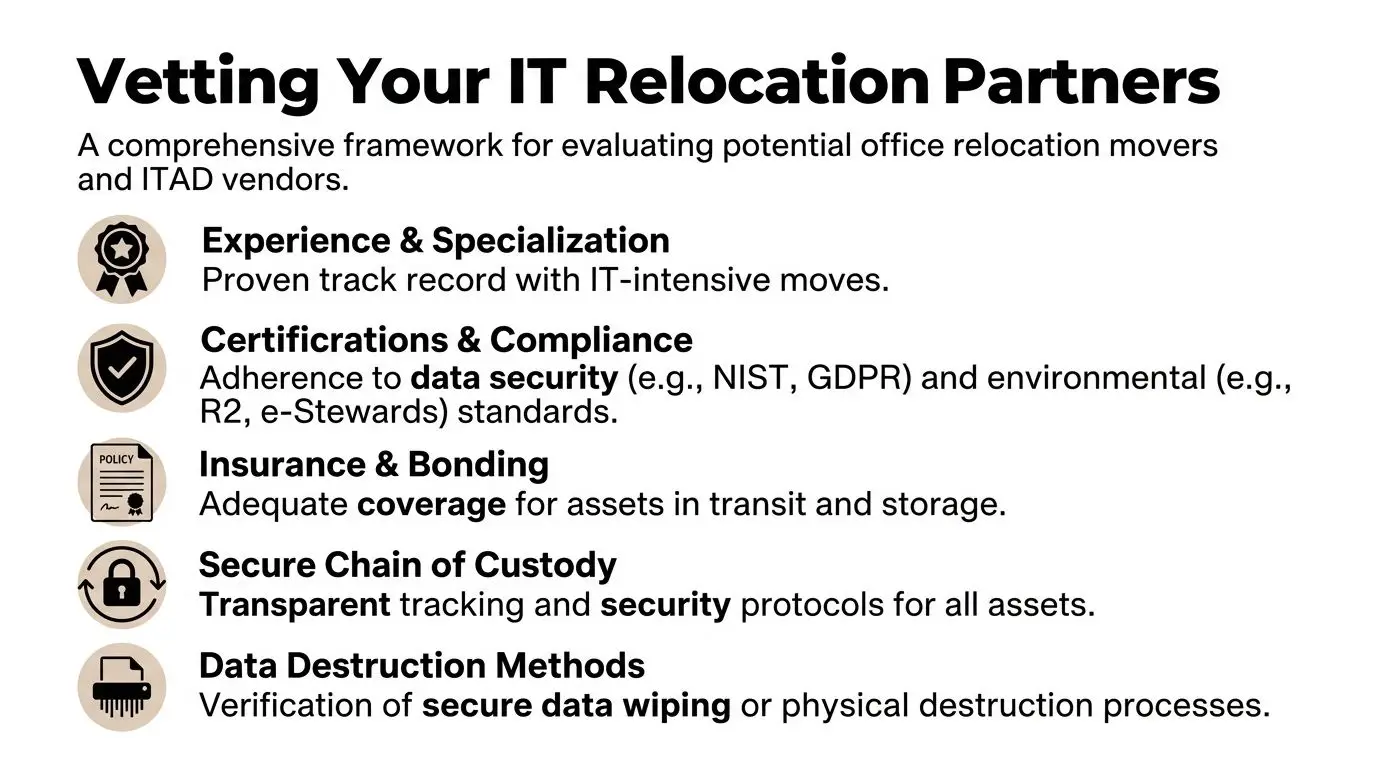
Vetting Your Office Relocation and ITAD Partners
The cheapest quote is often the most expensive decision in the project. Not because movers are dishonest, but because a low quote usually assumes a simple job. Enterprise relocations aren’t simple jobs. They involve serialized assets, restricted areas, timed cutovers, and disposal procedures that need proof.
Clancy’s office relocation checklist guidance ties structured checklists to 85-90% on-time completion and notes that inadequate IT coordination causes 40% of delays. That’s the reason to evaluate office relocation movers like operational partners, not interchangeable labor.
What to ask before signing anything
Ask direct questions and expect direct answers.
- How do you handle serialized IT inventory: If the answer is “we label everything,” that’s incomplete. You need scan points, reconciliation steps, and exception handling.
- Who disconnects and reconnects hardware: General movers shouldn’t be improvising server shutdowns or firewall moves.
- How do you secure retired media and devices: If they can’t explain chain of custody, stop there.
- What happens when access windows change: You want a contingency plan, not a shrug.
- What proof do you provide after destruction or recycling: Documentation is part of the service, not an extra.
General Movers vs. Specialized IT Relocation Partners
| Feature | Standard Office Movers | Specialized IT Movers & ITAD Partners |
|---|---|---|
| Asset handling | Built for furniture, files, and general office contents | Built for servers, endpoints, network gear, and storage media |
| Inventory control | Basic room or crate labeling | Serialized tracking and disposition status |
| Data security | Often limited or undefined | Chain of custody, media handling, destruction documentation |
| Technical coordination | Works around IT | Coordinates directly with IT shutdown and recovery plans |
| Compliance support | Usually general liability focused | Supports auditable handling for regulated environments |
The separating line is documentation
A credible partner can show their process, not just describe it. That means intake records, handoff controls, service descriptions, escalation contacts, and sample reporting. If they can’t produce that before the job, they won’t produce it after the job either.
For ITAD review, a formal checklist helps procurement and IT evaluate the same risks with the same criteria. A practical starting point is a vendor due diligence checklist that covers handling controls, security process, and documentation requirements.
If a vendor treats data-bearing devices like ordinary surplus, they’re telling you how they’ll handle your risk.
Where specialist partners earn their keep
A specialist doesn’t just move assets. They reduce decision fatigue in the highest-risk parts of the project.
Look for partners who can support:
Secure decommissioning
Devices that aren’t going to the new site should leave the project under a documented disposition path, not pile up in a conference room.
Packaging by device type
Monitors, laptops, rack gear, batteries, copiers, and lab or medical technology do not travel the same way.
Building and dock coordination
Specialized teams understand elevator holds, access badges, after-hours entry, and chain-of-signature requirements.
Exception management
Moves always produce exceptions. Missing power at a destination. A mislabeled pallet. A department that kept unapproved equipment. You want a vendor that escalates fast and documents the resolution.
One practical example is Beyond Surplus, which provides business pickup, data destruction documentation, and recycling records as part of commercial IT asset disposition workflows. In a relocation, that type of service fits best when the retired equipment stream is separated from the active move stream from day one.
Mastering IT Asset Logistics and Secure Disposition
Office relocation movers function either as an extension of your controls or as a source of exposure. The physical move and the data risk are linked. If your inventory is weak, your chain of custody will be weak. If your disposal path is vague, your audit trail will be vague too.
American Fargo’s office moving article cites a 2023 Gartner report stating 75% of data breaches during relocations stem from improper IT disposal, and that only 12% of mover websites mention data wiping or chain-of-custody documentation. That gap matches what many IT teams run into. Plenty of vendors can move equipment. Far fewer can prove they handled retired assets correctly.
Start with a disposition-based inventory
Don’t inventory by room alone. Inventory by intended outcome.
Every asset should be marked as one of these:
- Relocate
- Redeploy internally
- Store temporarily
- Return to lessor
- Destroy data and recycle
- Hold for decision
That status belongs in the same record as serial number, user or department, physical location, and data-bearing status. If the asset contains storage media, note that clearly. If the drive has already been removed, record that too.
Use tags that answer operational questions
A good asset tag for a move doesn’t just identify the device. It tells the next team what to do with it.
Useful tag fields include:
- Destination zone or room
- Rack or desk assignment
- Priority class
- Handling instruction
- Disposition status
- Owner or cost center
Here, simple labels break down. You need a system that lets movers, IT technicians, and the ITAD vendor read the same intent from the same tag.
The label should tell a person whether the device gets installed, quarantined, or destroyed. If it only says “IT closet,” it’s not enough.
Know the difference between moving and decommissioning
These workflows must not overlap in staging.
Active production assets need protective packing, sequence-based loading, and direct delivery to a prepared destination. Decommissioned assets need locked containment, restricted handling, and documented transfer to the destruction or recycling stream.
When teams mix those streams, they create the classic errors. A retired laptop gets unpacked at the new office. A live firewall is sent to the recycler pile. A box of drives sits unattended because everyone assumed another team owned it.
Match the destruction method to the asset
Different media require different handling. The main point is not to sound technical. It’s to prevent fake certainty.
Data wiping
Use this when the media is healthy, supported, and intended for reuse or resale under a documented process. Wiping is an operational method, not a guess that deleting files is enough.
Degaussing
This applies to magnetic media in workflows designed for that method. It renders the media unusable, so it fits destruction, not redeployment.
Physical destruction
This is the right choice when the media is failed, highly sensitive, unsupported, or not worth reusing. It also simplifies the audit path for many organizations because the end state is obvious.
The right ITAD partner should explain which method they use by asset type and what documentation they issue afterward.
Treat chain of custody as a living record
Chain of custody starts before the truck leaves. It begins the moment a device is identified for retirement.
Track these handoffs:
- Removal from service
- Transfer to secure staging
- Pickup acknowledgment
- Transport intake
- Destruction or processing confirmation
- Final certificate issuance
This is why vendor vetting matters beyond pricing. General operational advice from South Mountain Window Cleaning vendor insights applies here too. You want providers whose process holds up under scrutiny, not just during sales calls.
White-glove handling for the risky edge cases
Not every device belongs in standard move crates. Executive systems, legal hold equipment, sensitive healthcare hardware, and infrastructure with embedded storage often need tighter controls. A white-glove service model is appropriate when chain of custody, room-by-room removal, and controlled handoff matter as much as transport.
The documents you need at the end
For retired assets, close the loop with records that match your internal inventory. At minimum, that means a reconciled asset list and the vendor’s destruction or recycling documentation. If those records don’t tie back to your serials and pickup batch, the paperwork won’t help much in an audit.
The best relocation projects make disposition boring. No mystery pallets. No orphaned drives. No unclaimed equipment left under a table after cutover.
Executing the Move with Precision and Control
Move weekend is controlled chaos when the prep work is solid. It’s unmanaged chaos when the prep work is weak. The difference isn’t energy or effort. It’s whether every team knows what happens first, what waits, and who has authority when something breaks from plan.
Run the move by sequence, not by department
Departments think in terms of their own equipment. IT has to think in dependency order. Core network, internet handoff, security systems, server and storage recovery, critical printers, shared devices, then standard endpoints. If the order is wrong, people may have their monitors while the business still can’t operate.
A practical run sheet for move day should include:
- Old site shutdown window: Confirm backups, system owners, shutdown order, and signoff
- Loading sequence: Priority gear first, general office equipment later
- Transit controls: Named contacts for both sites and exception escalation
- New site readiness check: Power, cooling where needed, racks, uplinks, and access credentials
- Recovery sequence: Network first, then authentication-dependent systems, then user devices
Keep one command channel
Don’t let every department call the movers directly. Use one relocation lead and one IT lead. That prevents contradictory instructions and undocumented changes.
If your team is decommissioning legacy hardware during the move, keep the operational checklist visible. A practical reference is this server decommissioning checklist, which helps teams separate shutdown, removal, media handling, and final disposition tasks.
During execution, speed comes from fewer decisions in the moment. The decision-making should already be done.
What the IT team should physically oversee
IT should not disappear into conference calls during the move. Someone from IT needs eyes on the highest-risk activities at both ends.
That includes:
Disconnection and packing
Photograph rack layouts if needed. Label cables and ports before removal. Keep rails, screws, power cords, and transceivers with the right hardware or in controlled kits.
Arrival and placement
Verify that equipment lands where the move matrix says it should, not where there happens to be open floor space.
Startup and validation
Bring systems online in order. Test authentication, line-of-business apps, printing, wireless, and shared devices before declaring success.
Exception logging
If something arrives damaged, late, or unlabeled, log it immediately with owner, device ID, and action taken. Don’t rely on memory after the weekend.
Communicate like the business depends on it
Because it does. Employees can tolerate temporary inconvenience if they know what’s happening. They struggle when they show up and no one can tell them whether they should work remotely, wait for setup, or bring in a replacement device.
Short, useful updates work best:
- What’s completed
- What’s delayed
- What users should do next
- Where to get support
The most effective move weekends feel uneventful from the employee side. That’s a sign the command structure held.
Post-Move Verification and Future-Proofing
A move isn’t done when the last crate is empty. It’s done when the inventory reconciles, the disposal records are in hand, the users are stable, and the team has captured what needs to change next time.
Reconcile assets before the project closes
Start with the master inventory and verify where each category landed. Moved assets should be physically present and operational. Stored assets should have a documented location and owner. Retired assets should map to pickup records and final destruction or recycling documentation.
For the compliance side, keep the project file complete. A practical artifact to validate against is a destruction certificate template. It helps teams confirm they received the right details for internal records and future audits.
Fix the human side early
Technical cutover and employee recovery happen on different timelines. Allen and Son’s office movers article notes that 68% of employees report stress-induced productivity drops of 20-30% for 2-4 weeks after a move. That’s a reminder that a technically successful move can still drag if users feel disoriented, unsupported, or left to rebuild their own setup.
Support recovery with practical steps:
- Floor-walking IT support: Put technicians where users need help
- Fast replacement process: Resolve missing peripherals and damaged accessories quickly
- Short orientation guides: Wi-Fi, printing, room booking, badge access, and support channels
- Manager check-ins: Surface team friction before it becomes downtime
A smooth first week after the move protects morale as much as uptime.
Hold a real post-mortem
Don’t settle for “it went fine.” Pull the relocation lead, IT, facilities, and key vendors into one review. Document what failed, what nearly failed, and what was overengineered.
Good post-mortem questions include:
- Which decisions paid off
- Which approvals slowed the team down
- Where chain of custody was strongest
- Which vendors handled exceptions well
- What should be standardized for the next site change, decommissioning, or refresh cycle
The longer-term benefit is bigger than the move itself. A disciplined relocation produces better asset records, cleaner lifecycle controls, and a stronger operating model for every future IT project.
If your office move includes retired laptops, servers, drives, network gear, or other data-bearing equipment, contact Beyond Surplus for certified electronics recycling and secure IT asset disposal with documented data destruction and business pickup support.