
For businesses in Georgia, managing retired IT equipment is more than a simple disposal task—it's a critical strategic decision impacting data security, regulatory compliance, and your financial bottom line. Executed correctly, a professional Georgia technology recycling program not only safeguards your company's most sensitive information but also recovers residual value from depreciated assets. This guide provides a clear roadmap for IT managers, facility managers, and business owners on how to implement a secure, compliant, and cost-effective IT Asset Disposition (ITAD) strategy.
The Business Case for Professional Electronics Recycling in Georgia
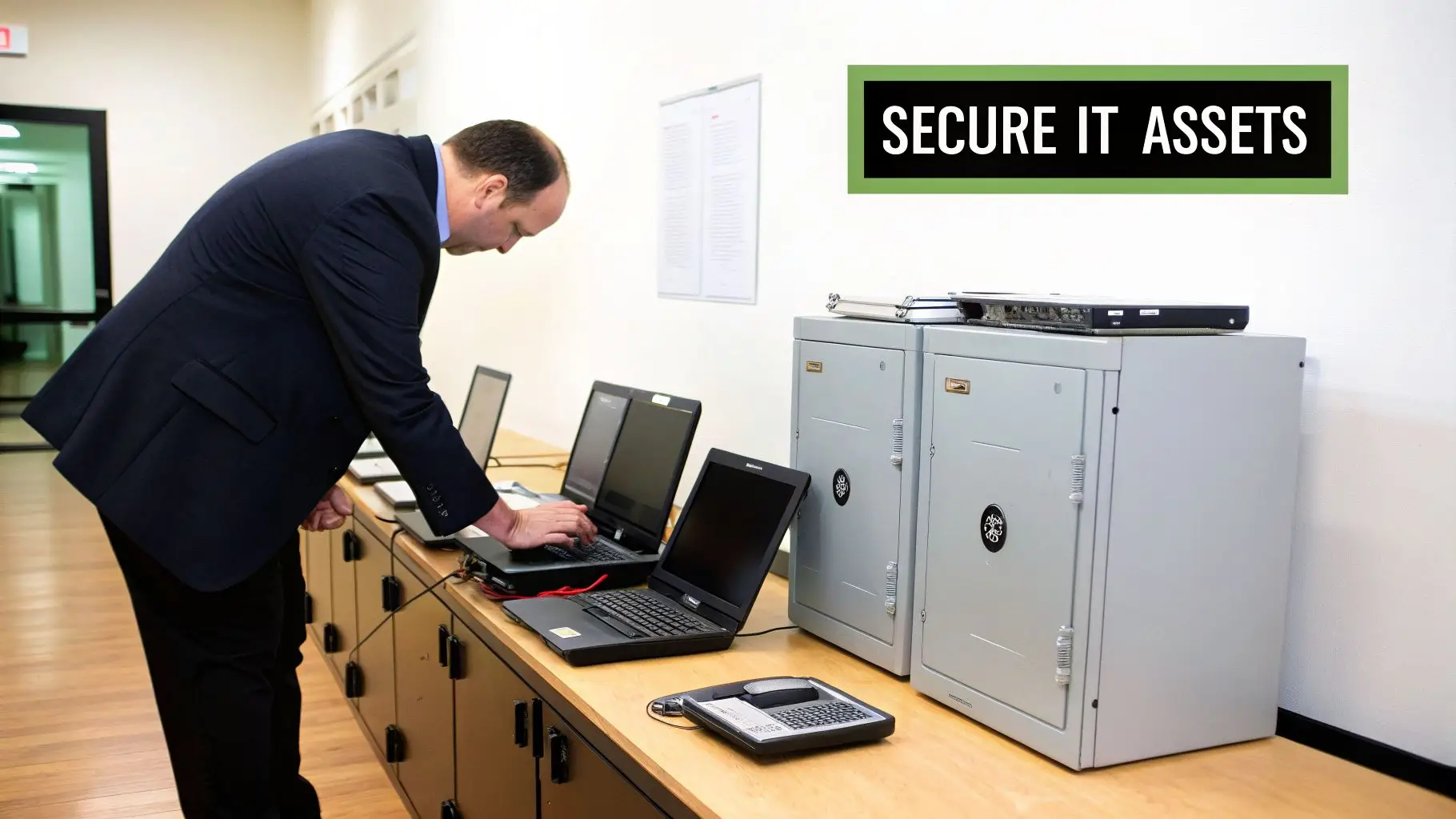
The volume of outdated electronics accumulating in Georgia is a growing operational and security risk for commercial enterprises. Every server, laptop, desktop, and smartphone being decommissioned contains a combination of potentially hazardous materials and, more importantly, sensitive corporate or client data. The relentless pace of technology upgrades fuels this challenge, making a proactive disposal strategy essential.
The environmental statistics are telling. As far back as 2014, Georgia generated approximately 21,000 tons of e-waste annually. Projections indicate that by 2027, the state's electronics consumption will reach 52,000 tonnes per year—a staggering 147% increase in just over a decade. With a circularity rate (the percentage of material recycled back into the economy) of only 1.48%, it is evident that standard disposal methods are unsustainable and irresponsible for businesses.
Why a Proactive ITAD Plan is a Corporate Necessity
Viewing obsolete technology as mere "junk" is a dangerous and outdated perspective for any Georgia business. A more accurate analogy is to see each retired asset as a locked safe. Opened correctly by a certified professional, it can yield value. If mishandled or lost, it becomes a significant liability. A formal IT Asset Disposition (ITAD) strategy is engineered to manage both outcomes effectively.
An ITAD program is not a disposal expense—it is an investment in risk mitigation. It contractually transfers the liability for your data security and environmental compliance from your organization to a certified vendor.
A common misstep is equating ITAD with a simple drop-off at a local recycling center. A true enterprise-grade ITAD program is a comprehensive, documented process designed to protect your business at every stage.
The Four Pillars of a Corporate Technology Recycling Program
To construct a resilient and effective program, your business must address four core pillars. Overlooking any one of these pillars exposes your organization to significant financial, legal, and reputational risk.
| Pillar | Commercial Importance for Your Business | Risk of Negligence |
|---|---|---|
| Data Security | Guarantees every byte of proprietary, employee, and customer data is verifiably destroyed beyond recovery. | Data breach fines, reputational damage, and erosion of customer trust. |
| Regulatory Compliance | Ensures adherence to federal and industry-specific laws like HIPAA, FACTA, and GLBA, preventing severe financial penalties. | Crippling regulatory fines, legal action, and potential operational sanctions. |
| Value Recovery | Identifies functional equipment suitable for refurbishment and resale, recouping a portion of the initial capital investment. | Forfeiting recoverable revenue and incurring higher net costs for technology refresh cycles. |
| Environmental Responsibility | Ensures all non-reusable materials are processed in compliance with environmental regulations, preventing pollution and landfill diversion. | Negative publicity, brand erosion, and alienation of environmentally-conscious clients and stakeholders. |
By prioritizing these four pillars, your organization can transform its electronics disposal process from a cost center into a strategic asset management function. Navigating the requirements for environmentally responsible recycling in Georgia is the first step toward finding a certified partner to protect your business interests.
Navigating E-Waste Regulations and Corporate Compliance in Georgia
Understanding the regulatory landscape for Georgia technology recycling can seem complex, but it is a fundamental component of corporate risk management. While Georgia lacks a single, state-wide e-waste mandate for all businesses, this does not absolve your company of its legal obligations.
Your operations are governed by powerful federal regulations, chief among them being the Environmental Protection Agency's (EPA) Resource Conservation and Recovery Act (RCRA). RCRA establishes the framework for managing hazardous waste throughout the United States. Many common electronic devices—from older CRT monitors to server UPS batteries—contain materials like lead, mercury, and cadmium, which are classified as hazardous waste under RCRA.
Disposing of these items in a standard commercial dumpster constitutes improper disposal and can subject your business to substantial fines and legal repercussions. Compliance is not optional; it is a federal requirement for all Georgia businesses.
Industry-Specific Data Security Mandates
Beyond the federal environmental laws, a stricter set of regulations applies depending on your industry. These mandates shift the focus from the physical hardware to the sensitive data stored within it.
Several key federal laws impose stringent requirements for data handling and the disposal of data-bearing devices:
- HIPAA (Health Insurance Portability and Accountability Act): For any entity in the healthcare sector—including providers, insurers, and their business associates—HIPAA compliance is mandatory. It requires that all protected health information (PHI) be rendered completely unreadable and irrecoverable before a device is disposed of.
- GLBA (Gramm-Leach-Bliley Act): This act applies to financial institutions such as banks, investment firms, and mortgage lenders. GLBA mandates the protection of sensitive customer financial data, including strict protocols for its secure disposal.
- FTC Disposal Rule: This rule applies broadly to nearly any business that maintains consumer information. It requires companies to take reasonable measures to prevent unauthorized access to that data during the disposal process.
Failure to comply with these industry-specific regulations can result in crippling financial penalties, severe reputational damage, and a complete loss of customer trust. For a more detailed review of these obligations, see our guide on compliant IT disposal in Georgia.
The Unbreakable Chain of Liability
A critical concept for every business owner and IT manager to understand is that liability for data breaches and improper disposal remains with the originating company. This responsibility does not disappear when the equipment is picked up by a disposal vendor.
Your company is legally responsible for the data on its retired assets until that liability is formally transferred to a certified vendor. This transfer is not a verbal agreement; it requires official and verifiable documentation.
This is precisely why partnering with a professional ITAD vendor is indispensable. A certified partner provides a Certificate of Destruction and a detailed chain of custody report. These documents serve as your legal proof of compliance, demonstrating that the data was destroyed according to industry standards and the materials were managed in an environmentally sound manner. Without this formal documentation, your company remains exposed to legal and financial risk.
Secure Data Destruction: The Core of Responsible ITAD
Once regulatory requirements are understood, the focus shifts to the most critical component of any IT asset disposal plan: secure data destruction. For any business in Georgia, this is a non-negotiable step in the ITAD process.
Relying on simple file deletion or a factory reset is a common but dangerous mistake. These methods create a false sense of security, as the data often remains recoverable with specialized software, leaving your organization vulnerable to a breach. Professional data destruction ensures that information is permanently and verifiably eliminated.
Three Primary Methods for Enterprise Data Sanitization
To guarantee data is irretrievable, certified ITAD vendors like Beyond Surplus employ specific, industry-approved methods. The optimal method depends on the asset's potential for reuse and the sensitivity of the data it contains.
The three primary methods of data sanitization are:
- Data Wiping (Erasure): A software-based process that overwrites the entire storage device with random binary data, often in multiple passes. This method completely sanitizes the drive while preserving its functionality, making it ideal for assets intended for resale and value recovery.
- Degaussing: This hardware-based method uses a powerful magnetic field to destroy the magnetic domains on a hard drive or magnetic tape where data is stored. It is extremely fast and effective but renders the drive permanently inoperable.
- Physical Destruction (Shredding): When data security is the absolute priority, or when a drive has no resale value, physical destruction is the definitive solution. The device is fed into an industrial shredder that reduces it to small, unrecoverable fragments of metal. This is the ultimate security measure.
Selecting the appropriate method is key to balancing maximum security with optimal financial return. For more details on these techniques, review our complete guide to secure data destruction services in Georgia.
The Importance of a Documented Chain of Custody
Equally as important as the destruction method is the chain of custody. This is the documented, chronological trail that tracks your assets from the moment they leave your facility to their final disposition.
A secure chain of custody is more than a logistical record; it is a legally defensible document. It demonstrates to auditors, regulators, and legal counsel that your organization maintained end-to-end security and control over its sensitive data.
This documentation provides a timestamped log of every handoff, recording who handled the assets, where they were transported, and how they were ultimately processed or destroyed. A transparent and unbroken chain of custody is a standard service offering from any reputable, certified ITAD partner.
This decision tree provides a visual guide for maintaining compliance with retired corporate assets.

As the flowchart illustrates, if an asset contains data, certified destruction is the only compliant path. If it does not, the asset must still be managed according to RCRA standards for responsible environmental disposal. This demonstrates how data security and environmental responsibility are inextricably linked in a professional Georgia technology recycling program.
How to Select a Certified ITAD Vendor in Georgia
Choosing the right partner for your company's retired technology is a pivotal decision in the IT Asset Disposition (ITAD) process. For businesses in Georgia, this selection should be based on trust, certified security, and proven compliance, not just on cost. A qualified vendor acts as your primary defense against data breaches and regulatory fines.
The most critical qualifying factor is third-party certification. Standards like R2v3 and e-Stewards are the gold standard in the ITAD industry and should be considered non-negotiable requirements. These certifications offer objective proof that a vendor adheres to the highest industry benchmarks for data security, environmental processing, and occupational health and safety. An uncertified recycler cannot provide these guarantees, leaving your business exposed to significant risk.
Understanding Key ITAD Vendor Certifications
It is essential to understand what these certifications signify for your business. They represent a deep, ongoing commitment to best practices and have a direct impact on your security posture, compliance record, and corporate reputation.
| Certification | What It Guarantees | Primary Benefit to Your Business |
|---|---|---|
| R2v3 (Responsible Recycling) | A comprehensive standard covering data security, environmental protection, and worker health. It mandates a documented chain of custody from origin to final disposition. | Ensures your data is secure, your company remains compliant, and your brand reputation is protected from the negative consequences of improper e-waste disposal. |
| e-Stewards | Renowned for its stringent environmental standards, e-Stewards enforces a zero-landfill policy and prohibits the export of hazardous electronic waste to developing countries. | Provides the highest level of assurance that your e-waste will not contribute to global pollution, aligning with robust corporate social responsibility (CSR) initiatives. |
| NAID AAA | Focused specifically on secure data destruction, this certification verifies that a vendor's shredding and wiping processes are secure, compliant, and subject to ongoing, unannounced audits. | Delivers undeniable proof that your data destruction methods meet the highest security protocols, which is critical for satisfying auditors and regulatory bodies like HIPAA. |
When vetting potential partners, your first step should be to request copies of their current certificates. Any hesitation or inability to provide proof of an active R2v3 or e-Stewards certification is a major red flag, and you should cease consideration of that vendor. To better understand this requirement, read our detailed analysis on what R2 Certification means for your business.
Critical Questions to Ask Potential ITAD Vendors
Once certification is verified, it's time to assess the vendor's operational capabilities and service quality. Your goal is to find a partner who provides seamless logistics, robust security, and transparent documentation.
The right ITAD partner doesn’t just remove your old equipment; they formally assume the liability associated with it. Their services and documentation are your primary defense in an audit or compliance inquiry.
Use these questions as a checklist during your evaluation:
- Can you provide a complete, serialized chain of custody? Request a sample report to see how they track assets by serial number from your facility to final disposition.
- Do you offer both on-site and off-site data destruction services? A flexible vendor should provide both options, including on-site shredding for maximum security and witness verification.
- How do you audit and manage your downstream recycling partners? Certified vendors are required to vet their downstream processors. Ask them to explain their process to ensure every component is handled responsibly.
- What specific details are included on your Certificate of Destruction? This is a legal document that formally transfers liability. It must list the serial numbers of the specific devices that were destroyed to be valid.
Selecting a vendor based solely on the lowest price is a common and costly mistake. The right partner in Georgia will deliver comprehensive security, auditable documentation, and the expertise needed to protect your organization from risk.
Unlocking Financial and Environmental Benefits
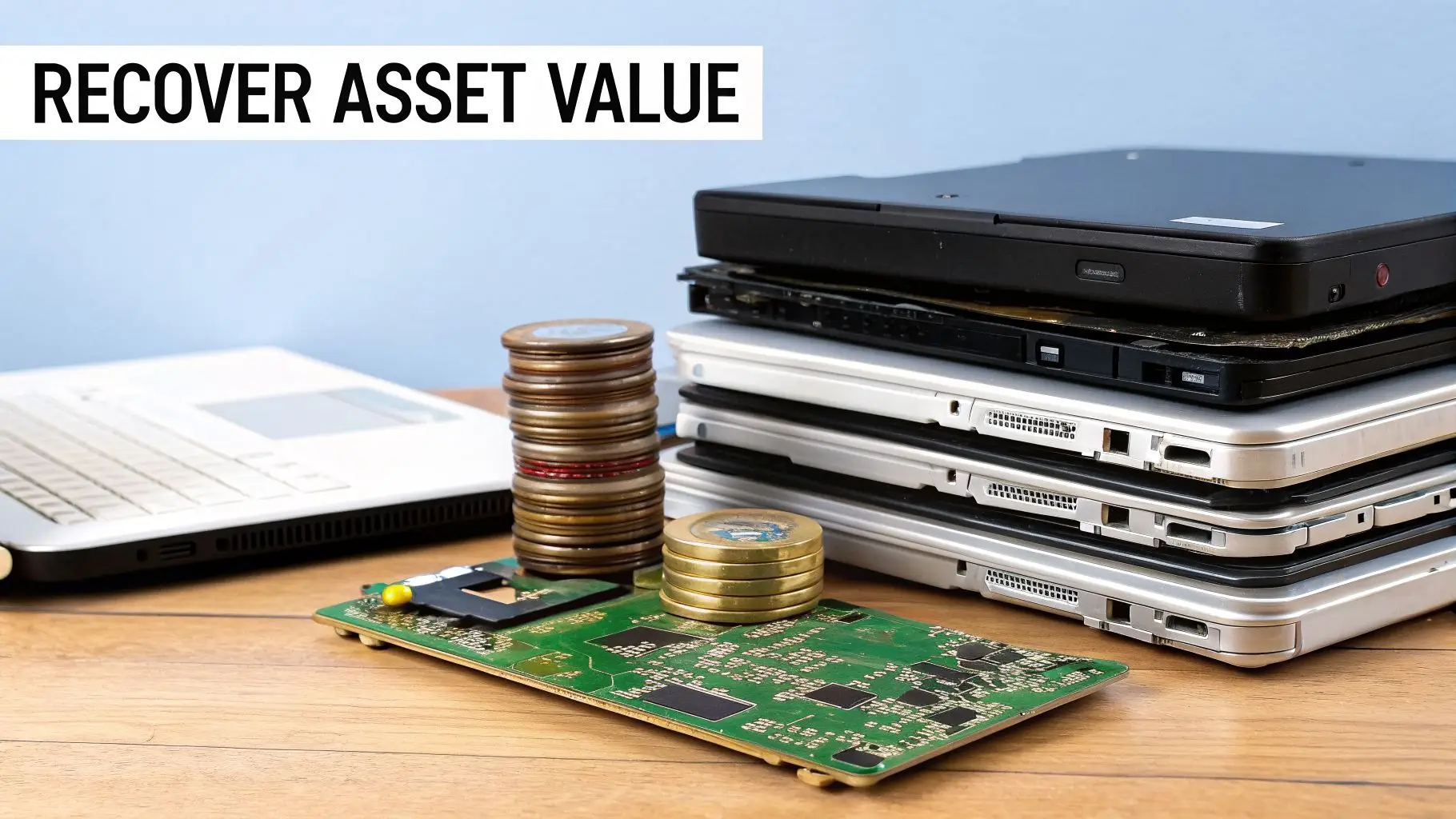
Historically, businesses viewed technology disposal as a pure cost center. However, a modern IT Asset Disposition (ITAD) program can transform this obligation into a strategic advantage, generating revenue and enhancing your company’s environmental credentials. Instead of an expense, view your retired IT portfolio as a source of recoverable capital. A professional approach to Georgia technology recycling not only mitigates risk but actively unlocks financial value.
Turning Retired IT Assets into Revenue
The most direct financial benefit comes from IT asset remarketing and buyback programs. Many enterprise-grade devices, such as recent-generation laptops, servers, and networking gear, retain significant value in the secondary market. A qualified ITAD partner has the expertise to assess, refurbish, and resell these assets through established global channels. This process allows your company to recover a portion of its original investment, which can then be used to offset the cost of a technology refresh, transforming a disposal liability into a revenue stream.
A professional IT buyback program is a powerful financial tool. It converts depreciating assets into liquid capital, effectively lowering the total cost of ownership for your IT infrastructure.
To maximize returns, partner with a vendor that has deep expertise in the secondary IT market. Their proficiency in testing, data sanitization, repair, and sales directly translates into a higher value recovery for your business. To see how this can benefit your organization, learn more about our asset recovery services in Georgia.
The Profitability of Environmental Sustainability
Beyond direct financial returns, responsible electronics recycling offers significant environmental benefits that align with modern Corporate Social Responsibility (CSR) objectives. Partnering with a certified R2v3 or e-Stewards recycler ensures that valuable materials are reclaimed from your obsolete devices instead of being landfilled. This includes precious metals such as:
- Gold
- Copper
- Palladium
- Aluminum
Recovering these materials reduces the environmental impact of mining and supports a circular economy, where end-of-life products provide the raw materials for new manufacturing. This is the type of sustainable practice that customers, investors, and top-tier talent increasingly expect from leading companies. By embracing a strategic ITAD program, Georgia companies can demonstrate that sustainable practices and profitable operations go hand in hand.
Frequently Asked Questions About Georgia Technology Recycling
When decommissioning office electronics, business owners and IT managers in Georgia frequently encounter the same questions. Below, we provide clear, direct answers to help you make secure and compliant decisions for your retired IT assets.
Is my business legally required to recycle electronics in Georgia?
While Georgia does not have a single state law compelling every business to recycle electronics, your company is subject to federal and industry-specific regulations. The EPA's Resource Conservation and Recovery Act (RCRA) prohibits the disposal of electronics containing hazardous materials in standard commercial waste. More importantly, data privacy laws like HIPAA (healthcare), GLBA (finance), and the FTC Disposal Rule hold your business liable for data breaches from improperly discarded devices. Partnering with a certified ITAD vendor and obtaining a Certificate of Data Destruction is the most effective way to meet these legal obligations and transfer liability.
What is the difference between a recycler and a certified ITAD vendor?
This distinction is critical for managing business risk. A standard recycler may simply collect and scrap equipment for its commodity material value, often with little to no focus on data security or providing a documented audit trail. A certified ITAD (IT Asset Disposition) vendor, in contrast, provides a comprehensive, secure, and documented service that includes:
- A secure, serialized chain of custody from your facility to final disposition.
- Certified data destruction using professional software wiping or physical shredding.
- Detailed reporting and a legal Certificate of Destruction for your compliance records.
- Value recovery through professional IT buyback and remarketing services.
A certified ITAD vendor is a risk management partner; a basic recycler is a disposal service that can leave your company exposed.
Can our business get money back for our old office computers?
Yes, absolutely. Many types of business-grade IT equipment, particularly assets that are less than five years old and in good working condition, retain significant resale value. Laptops, servers, networking hardware, and enterprise storage systems are often in high demand on the secondary market. Through a professional IT buyback program, a certified ITAD partner will assess, test, and offer fair market value for your functional equipment. This revenue can be returned to your company as cash or as a credit toward recycling services, directly offsetting the costs of your next technology refresh.
How do I arrange a pickup for my business in Georgia?
The process is designed to be secure and straightforward. First, compile an inventory of the equipment you need to dispose of. Next, contact a certified ITAD vendor to request a quote and schedule a pickup. A professional logistics team will then coordinate the secure packing and transport from your facility anywhere in Georgia, ensuring the entire process is seamless, secure, and fully documented from start to finish.
Contact Beyond Surplus for certified electronics recycling and secure IT asset disposal. We provide professional, compliant, and reliable services for businesses across Georgia and the United States. Get your free quote today by visiting https://westhilldentalpeaceriver.com.