
For businesses in Georgia, the disposal of end-of-life electronics is a critical task governed by strict federal rules designed to protect sensitive data and ensure environmental compliance. Because Georgia does not have a state-specific e-waste mandate, the full weight of compliance for Georgia secure electronics disposal falls directly on your company. This makes understanding your obligations under federal laws like the FTC Disposal Rule and the EPA's Resource Conservation and Recovery Act (RCRA) essential for any commercial or enterprise operation.
Understanding Georgia's Unique E-Waste Landscape
The absence of a statewide e-waste recycling program in Georgia creates a complex compliance environment for businesses. Unlike states with stringent landfill bans, Georgia’s approach leaves the responsibility of compliant disposal squarely with the asset owner. However, this regulatory gap does not mean businesses are free from obligation. On the contrary, you are fully bound by powerful federal laws covering data privacy and hazardous waste management for all commercial IT equipment.
This situation presents both a challenge and an opportunity. The burden is on your organization to establish and follow compliant disposal methods without state-level guidance. By partnering with a certified IT Asset Disposition (ITAD) vendor, you can transform this potential liability into a clear demonstration of corporate responsibility and effective risk management, ensuring your Georgia secure electronics disposal process is secure and documented.
The Federal Rules That Still Apply
Even without a Georgia mandate, your business has significant legal responsibilities. Several key federal laws are very clear about how you must handle devices that hold data and other electronic waste.
To give you a clearer picture, here’s a breakdown of the regulations that matter most for Georgia businesses, even without a state-specific law.
Key Regulations Affecting Georgia Businesses
| Regulation/Guideline | Governing Body | Key Requirement for Businesses | Relevance in Georgia |
|---|---|---|---|
| FTC Disposal Rule | Federal Trade Commission (FTC) | Must take "reasonable measures" to protect consumer information during disposal. | Directly applies. Throwing a hard drive in a dumpster is a clear violation. |
| HIPAA | Dept. of Health & Human Services | Electronic Protected Health Information (ePHI) must be rendered unreadable and unrecoverable. | Critical for any healthcare provider, insurer, or business associate in the state. |
| FACTA | Federal Government | Mandates the secure destruction of electronics containing consumer report information. | Affects a wide range of businesses, from lenders to employers who run credit checks. |
| RCRA | Environmental Protection Agency (EPA) | Governs the disposal of solid and hazardous waste, including materials in electronics. | Prevents dumping of items like CRT monitors or batteries with lead and mercury. |
The bottom line is that Georgia's lack of a state program means federal agencies are the primary enforcers of e-waste and data security regulations for businesses. While local initiatives exist, a comprehensive statewide program has not materialized.
Key Takeaway: Since Georgia has no state e-waste law, federal regulations are the law of the land for businesses. Disposing of electronics improperly isn't just bad for the environment; it's a major data security and financial risk.
Working with a certified IT Asset Disposition (ITAD) vendor is the most straightforward way to ensure compliance. A professional partner manages certified data destruction and responsible recycling, providing the documentation—including Certificates of Destruction and chain-of-custody reports—to prove you have met your obligations. For Georgia businesses, this makes professional Georgia secure electronics disposal a critical business function. You can see more about how Beyond Surplus provides compliant Georgia technology recycling solutions for companies across the state.
Building Your Internal Disposal and Data Security Plan
Before scheduling a pickup with an ITAD vendor, the most important work for Georgia secure electronics disposal begins within your own organization. A robust internal plan is crucial for a smooth, compliant process and protects your business from data security risks.
Establishing this framework creates a repeatable, auditable system for managing every piece of retiring IT equipment, from office computers to data center hardware.
Establishing Your Asset Inventory
You cannot protect what you do not track. The first step for any Georgia business is to build a detailed asset inventory. This master list should track every device slated for disposal, including servers, laptops, networking gear, medical devices, and laboratory equipment.
A simple spreadsheet can be effective, but thoroughness is key.
Your inventory should capture these key details for each asset:
- Asset Tag/Serial Number: The unique ID for tracking.
- Asset Type: (e.g., Laptop, Server, Switch, Medical Monitor).
- Brand and Model: Crucial for determining potential resale value.
- Physical Location: Department or office of origin.
- Data-Bearing Status: A simple Yes/No flag to identify devices requiring data destruction.
This document serves as the foundation of your disposal program and provides essential proof for audits.
Classifying Assets by Data Sensitivity
With your inventory complete, classify your assets based on the sensitivity of the data they contain. Not all data carries the same level of risk, and your security measures should reflect this. This proactive step ensures compliance with regulations like HIPAA, FACTA, and the FTC Disposal Rule.
For example, a healthcare provider in Augusta decommissioning equipment must treat a server that stored patient electronic Protected Health Information (ePHI) with a much higher security protocol than a kiosk computer from a public area.
Scenario in Practice: An Atlanta-based financial services firm is upgrading its employee laptops. Their internal plan would classify laptops from the accounting department as "High Risk" due to sensitive financial data and Personally Identifiable Information (PII). Laptops from the marketing department might be flagged as "Medium Risk." This classification dictates the required level of data destruction, such as on-site shredding for the highest-risk devices.
This flowchart maps out the compliance journey for businesses in Georgia. It's a straightforward path that shows why a certified partner is essential.
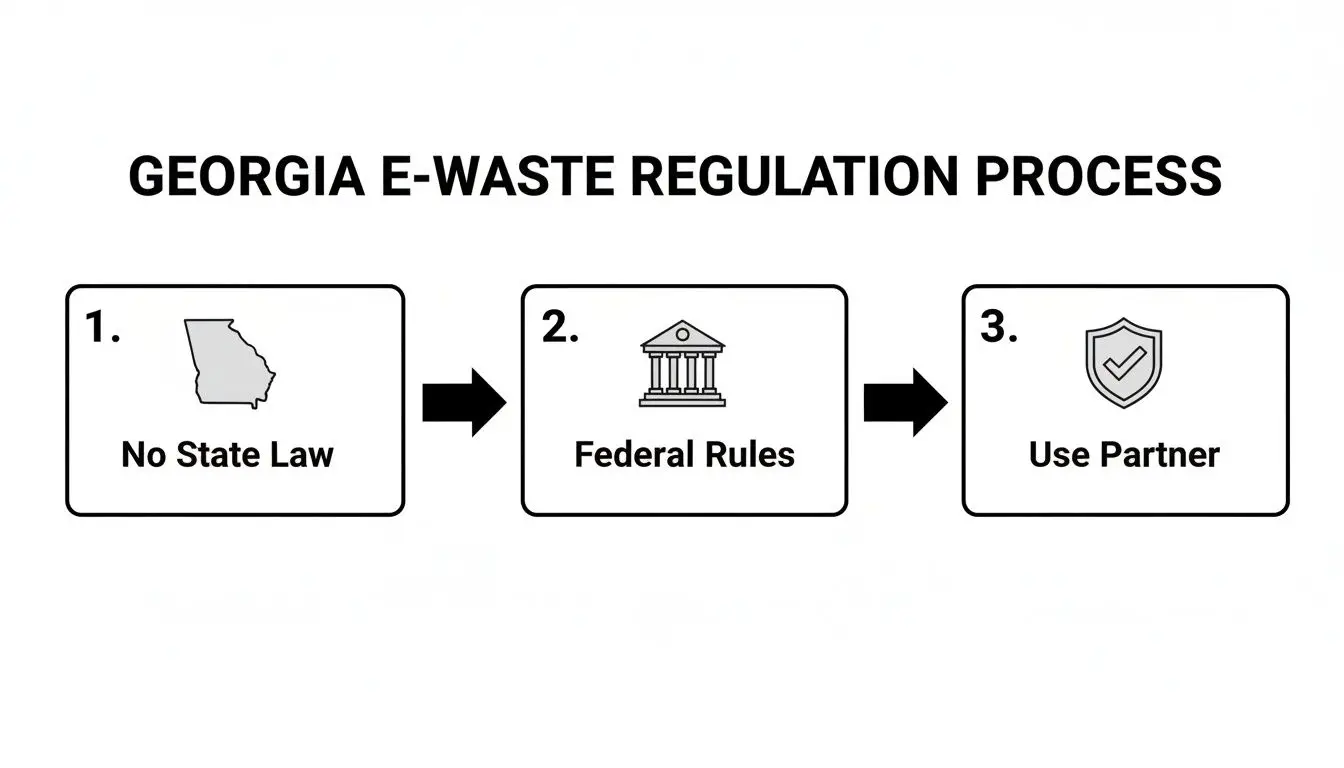
As you can see, even without a specific state law, federal rules are in full effect, making a certified partner the final, non-negotiable step for compliance.
Documenting Your Process and Policies
The final piece of your internal plan is to document everything in a formal policy. A written policy creates consistency and provides a clear playbook for all employees. It should outline the exact steps for identifying, inventorying, classifying, and staging assets for pickup.
Your policy needs to be specific about the data destruction standards you require. For most businesses, this means adhering to established guidelines. You can learn more about the NIST 800-88 guidelines for media sanitization and how they apply to your retiring equipment.
A well-written policy should answer key questions like:
- Who is authorized to request an IT asset disposal pickup?
- What is the process for moving equipment to a secure holding area?
- What level of destruction is mandatory for each risk classification? (e.g., wiping for "Low Risk," physical shredding for "High Risk").
By creating this documented and repeatable process, you build a powerful internal control system that minimizes risk and turns Georgia secure electronics disposal into a predictable and manageable business operation.
On-Site vs. Off-Site Data Destruction: What's Right for You?
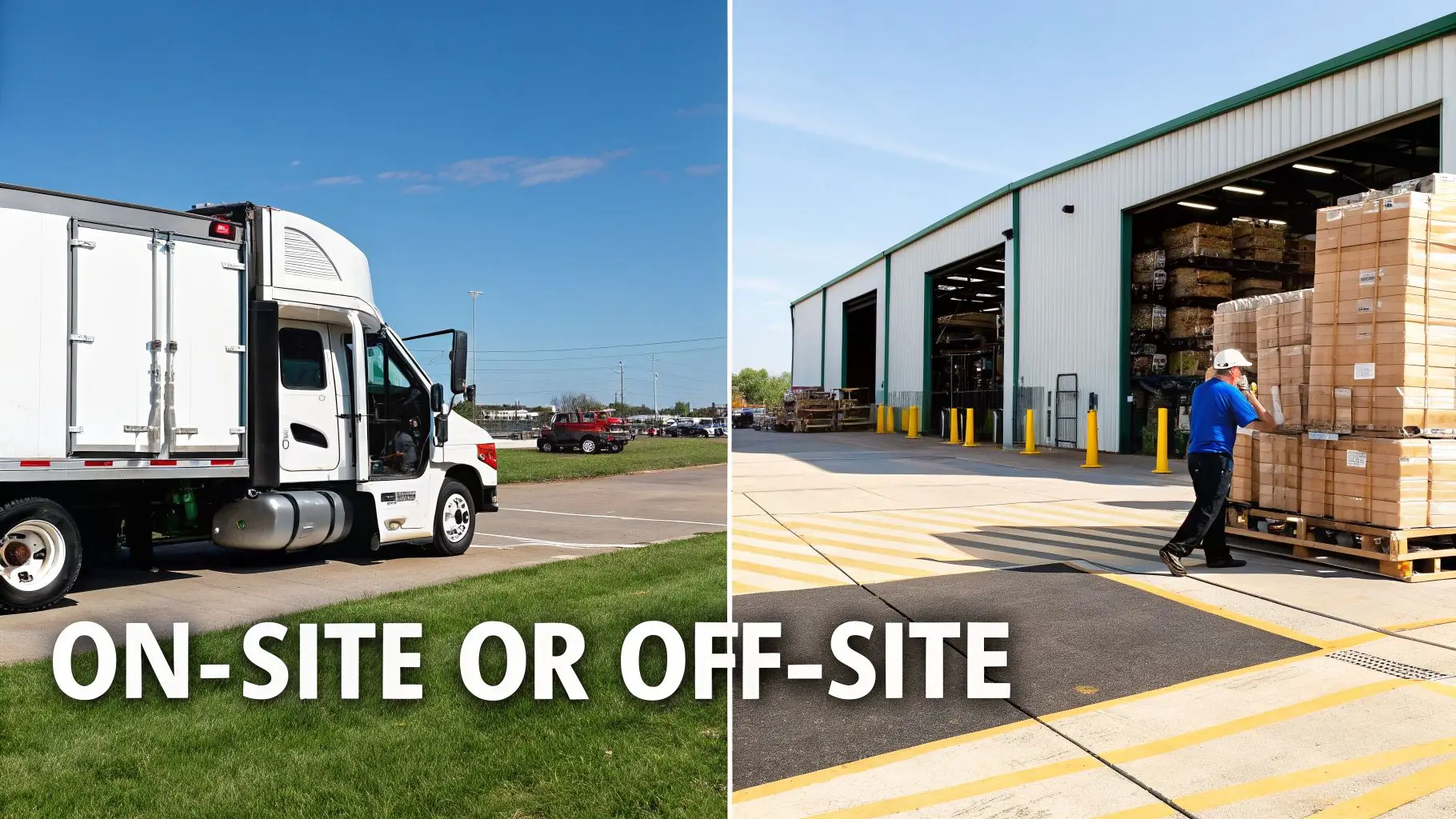
When it comes to Georgia secure electronics disposal, one of the most critical decisions is determining how and where your data will be destroyed. The choice between on-site and off-site data destruction depends on your company's security requirements, compliance mandates, logistics, and budget.
Consider a financial services firm in downtown Atlanta where an unbroken chain of custody is non-negotiable. They require witnessed, on-site shredding of hard drives to satisfy stringent regulations and internal security policies.
In contrast, a large manufacturing plant in Macon undergoing a full technology refresh may find off-site services more practical. For large volumes of assets, a secure, audited process at a specialized facility offers greater efficiency and cost-effectiveness without disrupting operations.
On-Site Data Destruction: The Ultimate in Security
On-site destruction brings the process directly to your business. A mobile shredding truck equipped with industrial-grade machinery arrives at your Georgia facility, allowing your team to witness the physical destruction of every hard drive, SSD, and backup tape.
This method offers several key benefits:
- Unbroken Chain of Custody: Data-bearing devices never leave your sight intact, eliminating the risk of loss or theft during transit.
- Immediate Verification: You receive a Certificate of Destruction on the spot, providing instant, auditable proof of data elimination.
- Maximum Security: This is the gold standard for organizations handling highly sensitive information, such as healthcare providers, financial institutions, and government contractors.
The primary trade-offs are cost and logistics. On-site services can be more expensive, especially for smaller quantities, and require adequate physical space to accommodate the service vehicle.
Key Takeaway: Choose on-site destruction when your compliance rules or internal risk policies require absolute, witnessed proof that data has been destroyed before the assets leave your property.
Off-Site Data Destruction: Efficiency and Scalability
Off-site destruction provides a secure and highly efficient alternative. Following a detailed inventory, your assets are transported in locked containers by vetted personnel to a secure, access-controlled facility. There, devices are destroyed according to your specifications, whether through NIST 800-88 compliant data wiping or physical shredding.
Off-site processing is ideal for:
- Large-Scale Projects: For businesses retiring hundreds or thousands of assets, this method is more manageable and cost-effective.
- Operational Efficiency: It minimizes disruption at your facility, allowing your team to focus on core responsibilities.
- Comprehensive Auditing: Reputable vendors provide detailed chain-of-custody documentation, GPS-tracked transport, and video surveillance of the destruction process.
This table breaks down the key differences to help you decide which option best fits your business needs.
On-Site vs. Off-Site Data Destruction: A Comparison for Georgia Businesses
| Feature | On-Site Destruction (at your GA location) | Off-Site Destruction (at a secure facility) |
|---|---|---|
| Security Level | Maximum. You witness the entire process. | Very High. Managed with a strict chain of custody. |
| Chain of Custody | Unbroken. Devices are destroyed before leaving. | Documented. Assets are tracked from pickup to destruction. |
| Verification | Immediate Certificate of Destruction. | Certificate of Destruction issued after processing. |
| Cost | Generally higher, especially for smaller volumes. | More cost-effective, particularly for large projects. |
| Logistics | Requires physical space for the truck and service. | Minimal disruption; vendor handles transport and logistics. |
| Best For | Strict compliance, high-risk data, and absolute peace of mind. | Large-scale tech refreshes, cost-efficiency, and operational convenience. |
While assets leave your site intact with off-site destruction, a robust chain-of-custody process—including serialized asset tracking, sealed transport, and detailed reporting—ensures full accountability.
Beyond Surplus provides expert guidance on these options; you can learn more about our on-site data destruction services in Georgia to see how we tailor solutions for maximum security. The right choice aligns with your operational needs and risk tolerance.
Why Certifications and Chain of Custody Matter
For any Georgia business serious about managing risk, proof of compliant disposal comes from two sources: vendor certifications and a documented chain of custody. A verbal promise is insufficient; you need verifiable evidence that your retired electronics were handled correctly.
Industry certifications like R2v3 and e-Stewards are not merely logos. They signify that a vendor has passed rigorous, third-party audits covering data security, environmental standards, and worker safety.
Engaging an uncertified vendor for your Georgia secure electronics disposal is a significant gamble. Without verified proof of compliance, you risk having your assets end up in a landfill or illegally exported, creating substantial legal and reputational liabilities for your company.
The Certifications That Count
When vetting an ITAD partner, two certifications are considered the gold standard, providing a clear benchmark for secure and responsible processing.
R2v3 (Responsible Recycling): This is one of the most respected standards in the industry. An R2v3-certified facility is audited on its entire process, from data wiping protocols and downstream vendor tracking to environmental practices. It ensures every component is handled transparently and safely.
e-Stewards: Developed by the Basel Action Network, the e-Stewards standard is intensely focused on preventing the illegal export of hazardous e-waste. It has some of the strictest requirements for data security and environmental protection, making it a top choice for businesses in highly regulated sectors.
Choosing a certified vendor provides immediate confidence in their processes and saves you the extensive effort of conducting your own due diligence.
The Power of a Solid Paper Trail
The documentation you receive after your equipment is processed is your ultimate proof of compliance. This "paper trail"—including a Certificate of Destruction and a chain-of-custody report—is what officially transfers liability from your business to the vendor and serves as your evidence in an audit.
A crucial component of this is the chain of custody: a detailed, chronological log that tracks every asset from your Georgia facility to its final disposition.
Here's a real-world example: A data center in Alpharetta decommissions its servers. The ITAD partner creates a serialized inventory of every server and storage device on-site. The list is signed, and the equipment is loaded into a sealed, GPS-tracked truck. Upon arrival at the secure facility, the seal is broken, and the inventory is re-verified. This meticulous process ensures full accountability and creates an auditable record.
Upon completion, you should receive a detailed chain-of-custody report and a Certificate of Destruction. These are not just receipts; they are legal documents. You can learn more about how this paperwork is key to compliance in our guide on data destruction services in Georgia.
The global challenge of managing e-waste makes these processes more important than ever. Worldwide, e-waste is growing five times faster than documented recycling efforts. According to the Global E-Waste Monitor, collection and recycling rates are actually expected to fall from 22.3% in 2022 to just 20% by 2030. This alarming trend is driven by rapid tech advances and shorter product lifecycles.
This global context is precisely why a certified, documented process is non-negotiable. By insisting on a robust paper trail, you protect your business and ensure you are part of the solution, not the problem.
Turning Old Tech into Revenue with ITAD Buyback Programs
Disposing of old technology doesn't have to be just an expense. For many Georgia businesses, a strategic IT Asset Disposition (ITAD) buyback program can turn retiring equipment into a new revenue stream.
This approach transforms Georgia secure electronics disposal from a cost center into a savvy financial decision. Instead of paying for disposal, a buyback program allows you to recover the residual value of equipment that still has life on the secondary market, often offsetting recycling costs and even generating a positive return for your company.
Identifying Assets with Resale Value
Not all retired electronics have monetary value. The key to a successful buyback program is identifying assets that still hold recoverable value. While a ten-year-old desktop is likely destined for recycling, more recent and specialized enterprise equipment can be in high demand.
The most valuable assets for resale typically include:
- Enterprise Servers: Newer-generation servers from brands like Dell, HPE, and Cisco.
- Networking Gear: Business-class switches, routers, and firewalls from manufacturers like Cisco, Juniper, and Arista.
- Laptops and Desktops: Bulk lots of recent-model corporate laptops and desktops.
- Data Storage Systems: SANs, NAS devices, and other storage arrays from top-tier brands.
The final value depends on age, condition, brand, model, and current market demand. A professional ITAD partner can assess your inventory and provide a fair market valuation for each asset.
How to Maximize Your Financial Return
A small amount of preparation can significantly increase your financial return. Properly preparing your assets makes them more attractive for remarketing and boosts your buyback offer.
To maximize your return from an ITAD buyback program, follow these best practices:
- Keep Equipment in Good Condition: Handle assets with care during decommissioning to avoid cosmetic damage that can lower resale value.
- Provide Detailed Specifications: Prepare an inventory list with exact model numbers, configurations (CPU, RAM, storage), and serial numbers for a faster, more accurate quote.
- Do Not Remove Components: Resist the temptation to pull RAM or hard drives. ITAD vendors purchase complete systems and factor all components into their valuation.
- Consolidate Assets: It is easier to sell larger quantities of identical equipment than a mix of different models. Group similar assets together when possible.
Taking these steps makes your equipment more appealing to an ITAD partner, translating directly into a higher payment. You can learn more about how we help Georgia companies maximize returns through our IT equipment resale services.
The Big Picture: While Georgia's e-waste output has been relatively low in the past, forecasts show a major uptick in consumption. Data from the Step-initiative showed Georgia produced 4.6 kg of e-waste per person back in 2014, but consumption was projected to hit 52,000 tonnes by 2027 as product lifecycles get shorter. This trend makes buyback programs more important than ever, offering a sustainable and financially smart way to manage the growing mountain of retired electronics. You can dig into the data in these e-waste flow projections in Georgia.
Partnering with an ITAD vendor for a buyback program is a strategic decision that delivers financial, operational, and environmental benefits, transforming secure electronics disposal from a mandatory task into an intelligent asset management function.
Partnering for Secure and Compliant Disposal in Georgia
Managing electronics disposal internally is a complex, resource-intensive task. Between navigating federal laws, mitigating data breach threats, and handling logistics, the process can divert focus from your core business operations. This is where a certified ITAD partner becomes invaluable.
Working with an expert doesn't just offload a task; it transforms a potential liability into a secure, streamlined, and even profitable part of your business. It's not about just getting rid of old equipment. It’s about protecting the business you’ve worked so hard to build.
An All-in-One Solution for Your Retired IT Assets
A certified ITAD vendor serves as your single point of contact, managing the entire disposal process from start to finish. At Beyond Surplus, we’ve designed our services specifically for the challenges Georgia businesses face, with a process built on security and transparency.
We provide a comprehensive solution so you can remain focused on your core business. Our services include:
- Logistics and Secure Pickup: Our fleet handles secure pickups for businesses across Georgia—from Atlanta to Savannah—and throughout the United States.
- Specialized Industry Expertise: We have extensive experience serving highly regulated sectors such as healthcare (HIPAA), finance (FACTA), and data centers.
- Convenient Local Drop-Off: For businesses in the Atlanta area, our Smyrna, Georgia facility offers a secure and convenient drop-off point for retired IT assets.
Our goal is to make the entire process seamless, removing risk and complexity from your operations. We manage everything from the initial pickup and inventory to the final Certificate of Destruction.
You’ve built your business with care; let us help you protect it. Partnering with a certified ITAD expert ensures every retiring asset is handled with the highest standards of security and environmental stewardship, giving you complete peace of mind.
Getting started is straightforward. Our team is ready to develop a custom disposal plan tailored to your specific needs. We will help you evaluate your inventory, explain the best options for data destruction and value recovery, and schedule a pickup at your convenience.
Ready to create a secure and compliant disposal strategy? You can easily schedule a pickup for your business online or get in touch for a custom quote on your equipment.
Frequently Asked Questions About Georgia E-Waste Disposal
IT managers and business owners in Georgia often have questions about securely disposing of old electronics. Having helped countless businesses navigate this process, we have compiled answers to some of the most common inquiries.
Here are straightforward answers from our team to the questions we hear most often from commercial clients.
What Does It Cost for a Business to Recycle Electronics in Georgia?
The cost depends entirely on the type and volume of your equipment.
For newer, high-value assets like recent-model enterprise servers or large quantities of corporate laptops, there may be no cost. In fact, through our ITAD buyback program, we may pay you for your equipment.
Conversely, older, non-value items or specialty equipment like bulky CRT monitors typically incur a recycling fee. We always provide a transparent, itemized quote upfront, ensuring there are no surprises.
Can You Handle the Disposal of Specialized Equipment?
Yes. Beyond Surplus is equipped to manage the secure disposal of a wide range of specialized assets beyond standard office IT equipment.
We regularly process:
- Medical Equipment: From patient monitors to complex diagnostic machines, we ensure all devices are handled in accordance with strict healthcare industry standards.
- Laboratory Equipment: We have experience with analytical instruments, sensitive testing devices, and other laboratory electronics that require secure and careful decommissioning.
Our process is designed to accommodate the unique data security and logistical needs of these specialized assets.
How Do I Schedule a Pickup If My Business Is Outside Atlanta?
Our services extend far beyond the Atlanta metro area. We operate our own fleet of vehicles and leverage a network of logistics partners to coordinate secure pickups for businesses anywhere in Georgia and across the contiguous U.S.
Contact our team to handle the logistics. Whether your business is located in Savannah, Augusta, or a more rural part of the state, we will arrange a direct pickup from your facility.
What Is the Real Difference Between Data Wiping and Shredding?
Both methods effectively destroy data, but they operate differently. Understanding the distinction is key to choosing the right method for your needs.
Data Wiping is a software-based process that overwrites every bit of data on a hard drive with random characters, rendering the original information unrecoverable. This method complies with rigorous standards like NIST 800-88 and allows the drive to remain physically intact for safe reuse or resale.
Physical Shredding, in contrast, is a process of complete physical destruction. A powerful machine grinds the hard drive into small metal fragments, providing definitive visual proof that the drive and its data are gone forever.
Partner with Beyond Surplus to ensure your Georgia business meets all compliance and security standards for electronics disposal. Contact us today for a complimentary quote and to schedule your secure pickup.