
For businesses in Georgia, managing a large volume of end-of-life electronics is a critical IT asset disposal (ITAD) function, not just a cleanup task. This process involves the secure, compliant, and strategic disposition of technology, from data center hardware to office desktops. Partnering with a certified IT asset disposal provider for bulk electronics recycling in Georgia is essential to ensure every asset is managed correctly, protecting your company from data breaches and environmental liability.
Why Georgia Is a Hub for Secure Commercial E-Waste Management
Georgia’s thriving business landscape and robust logistics network have established it as a key center for secure ITAD and commercial e-waste management. For IT directors, facility managers, and procurement professionals, this provides direct access to specialists capable of handling large-scale technology retirement projects seamlessly. This strategic advantage is particularly vital for companies in regulated sectors like finance, healthcare, and technology that require uncompromising data security and compliance.
Businesses across Georgia rely on specialized electronics recycling services for several key reasons that directly impact their operational risk, corporate reputation, and financial returns:
- Airtight Data Security: Preventing a data breach is the primary concern when disposing of IT equipment. Leading ITAD providers in Georgia offer certified data destruction, including on-site hard drive shredding, providing auditable proof that sensitive corporate information has been permanently eliminated.
- Achieving ESG Goals: Companies face increasing pressure to demonstrate their commitment to Environmental, Social, and Governance (ESG) principles. Responsible electronics recycling is a tangible way to meet sustainability targets, divert hazardous e-waste from landfills, and enhance your corporate social responsibility profile.
- Maximizing Value Recovery: Not all retired IT equipment is without value. An expert ITAD partner can identify assets with resale potential, offering IT buyback programs that return capital to your IT budget and help offset the costs of disposal.
Key Takeaway: Choosing a certified Georgia partner for bulk electronics recycling is a strategic business decision. It safeguards your company's data, reinforces its commitment to sustainability, and maximizes the financial return on retired technology investments.
The growth of the U.S. electronic goods recycling industry underscores this trend, with projections reaching $27.7 billion in revenue by 2025 and a 4.8% annual growth rate. This expansion is driven by the massive volume of e-waste, with the U.S. generating 6.9 million tons in 2023 alone. As a major economic hub, Georgia is central to this industry, with significant investments in processing infrastructure that position it as a national leader in commercial electronics recycling.
Key Considerations for Bulk Electronics Recycling in Georgia
This table outlines the critical factors your business must evaluate when planning a large-scale e-waste disposal project. Addressing these areas helps mitigate risks and uncover value recovery opportunities.
| Consideration | Why It Matters for Your Georgia Business | Recommended Action |
|---|---|---|
| Data Security & Destruction | A single data breach can result in severe fines, reputational damage, and legal consequences, especially in regulated industries like healthcare and finance. | Prioritize vendors with NAID AAA or similar certifications. Insist on on-site shredding options and a detailed Certificate of Data Destruction. |
| Environmental Compliance | Georgia has specific regulations, and federal laws like the Resource Conservation and Recovery Act (RCRA) apply. Improper disposal leads to significant penalties. | Only partner with R2v3 or e-Stewards certified recyclers to guarantee adherence to the highest environmental and safety standards. |
| Logistics & Transportation | Managing the pickup and transport of hundreds or thousands of assets is a complex process requiring secure, documented chain-of-custody protocols. | Select a provider with a dedicated, GPS-tracked fleet. Confirm they can manage palletizing, packing, and secure transport from your specific locations. |
| Asset Value Recovery (ITAD) | Newer or high-value equipment like servers, laptops, and networking gear can be resold, offsetting recycling costs and generating revenue. | Request a transparent valuation process. Inquire about their methods for testing, refurbishing, and remarketing assets, and understand their revenue-sharing model. |
| Reporting & Chain of Custody | An auditable paper trail is necessary to prove compliance and secure handling from the moment assets leave your facility to their final disposition. | Demand serialized asset reports and a complete chain-of-custody document for your compliance and internal audit records. |
Ultimately, these factors converge on a single objective: transforming a potential liability into a secure, compliant, and financially advantageous process.
Explore our Georgia electronics recycling service area to see how we assist businesses in managing these considerations statewide.
How to Prepare Your IT Assets for Bulk Recycling
A successful bulk electronics recycling project in Georgia begins with meticulous preparation long before any equipment is moved. A well-organized approach ensures a smooth, secure, and transparent handover to your ITAD partner, preventing the risks and logistical challenges that arise from disorganized asset collection.
The first step is to create a detailed asset inventory. This is not a simple headcount but a comprehensive spreadsheet that captures critical information for every device slated for disposal. This document serves as the foundation for maintaining a clear chain of custody.
Building a Bulletproof Asset Inventory
An effective inventory should document the following for each asset:
- Asset Tag Number: Your company's internal tracking identifier.
- Serial Number: The unique manufacturer-assigned identifier for the device.
- Device Type: Be specific (e.g., Dell Latitude 7490 Laptop, Cisco Catalyst 2960 Switch).
- Physical Condition: Note any significant damage or missing components, which is crucial for asset valuation.
- Location: Document the department, floor, or room where the asset is currently stored.
This detailed log is essential. It functions as the master checklist during pickup, ensuring every data-bearing device is accounted for. It also forms the basis for identifying equipment that may have resale value, directly impacting your potential return through an ITAD buyback program.
The following infographic illustrates the primary drivers for Georgia businesses when undertaking this process.
As the visualization demonstrates, the process prioritizes data security, followed by achieving sustainability goals, and finally focuses on recovering financial value.
Consolidating Equipment for Pickup
Once your inventory is finalized, the next step is to physically consolidate all assets. The goal is to minimize disruption to daily operations and facilitate a fast, efficient pickup. Designate a secure and accessible staging area—such as a conference room, an empty office, or a warehouse section—where all equipment can be gathered.
For businesses with multiple facilities across Georgia, centralizing equipment is even more critical. Coordinate with department heads to schedule the movement of assets to the designated staging area. This simple step prevents the pickup team from needing to navigate multiple floors or buildings, saving time and reducing security risks.
Find more practical advice in our guide on how to prep electronics for recycling.
Pro Tip: While consolidating, clearly separate data-bearing devices (laptops, servers, desktops) from non-data items (monitors, keyboards, cables). This helps the recycling team prioritize the most sensitive equipment for secure handling upon arrival.
Mastering Data Destruction and Security Protocols
When your Georgia business plans a bulk electronics recycling project, data security must be the top priority. Simply deleting files is insufficient, as residual data on hard drives, servers, and other storage media presents a significant liability. For any organization, especially those governed by regulations like HIPAA, SOX, or the FTC Disposal Rule, certified data destruction is a non-negotiable component of a robust risk management strategy.
Data sanitization for IT assets primarily involves two highly secure methods. Each offers distinct advantages, depending on your company's internal security policies and specific compliance requirements.
On-Site vs. Off-Site Destruction
A key decision is determining where the data destruction will occur. This choice impacts your chain of custody and the verification process.
On-Site Hard Drive Shredding: For maximum security and peace of mind, many businesses opt for on-site physical destruction. A mobile shredding truck comes to your Georgia facility, allowing you to witness hard drives being physically pulverized into irrecoverable fragments. This provides an unbroken chain of custody and immediate verification, making it the preferred method for high-security industries like finance and healthcare.
Secure Off-Site Destruction: Alternatively, assets can be securely transported in a GPS-tracked, locked vehicle to a certified facility for destruction. This method is highly efficient for large volumes of equipment and is conducted under constant video surveillance in a controlled environment. A reputable ITAD partner will provide a complete audit trail from pickup to final destruction.
To better protect sensitive information during IT asset disposition, it is helpful to understand essential data security best practices that cover your data's entire lifecycle.
The Importance of Certified Proof
Regardless of the method chosen, the most critical deliverable for your compliance records is the Certificate of Data Destruction. This legal document formally transfers liability from your company to your recycling partner.
This certificate is your official record. It details the serial numbers of every destroyed device, the date and method of destruction, and a statement confirming the data is permanently unrecoverable. It serves as your definitive proof of due diligence in the event of an audit.
In addition to physical shredding, data wiping is another valid sanitization method, particularly for devices intended for resale or remarketing. This process uses specialized software to overwrite data according to strict standards, such as the DoD 5220.22-M three-pass method.
For insights into the modern gold standard, you can learn more about the guidelines in NIST SP 800-88, which provides a comprehensive framework for media sanitization. The bottom line is that choosing a partner who provides certified proof for either wiping or shredding is non-negotiable for protecting your business.
Coordinating Logistics for E-Waste Pickup in Georgia
Arranging for the removal of hundreds or thousands of IT assets from your facility can seem like a logistical challenge. However, with a professional ITAD partner, the entire process is streamlined and secure. The key is effective logistical planning that minimizes disruption to your daily operations while maintaining a strict chain of custody from the moment the equipment leaves your control. This applies whether you are clearing out a downtown Atlanta office or a sprawling corporate campus.
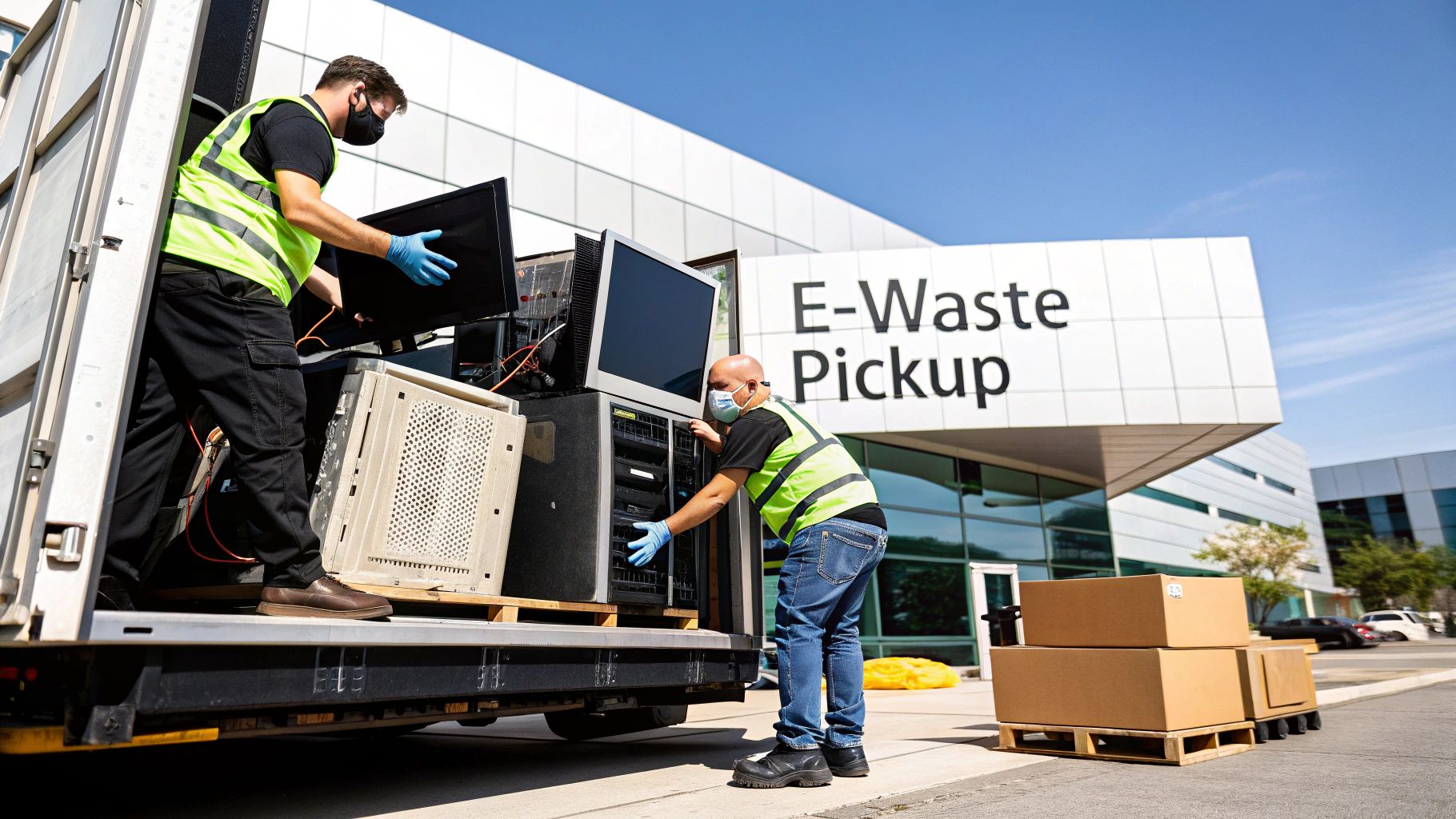
The first step is scheduling the pickup. A reliable partner will work around your business hours, offering flexible scheduling to avoid interfering with your team's productivity. They will also arrive with the appropriate vehicle for the job, from a box truck for an office refresh to a full-sized tractor-trailer for a data center decommissioning project.
Preparing Equipment for Secure Transport
Once a date is set, the focus shifts to preparing your assets for transit. While some businesses prefer to palletize their own equipment, a full-service provider will handle all preparation for you. Proper prep is essential for both safety and security.
- Palletizing: Equipment is stacked carefully onto pallets to ensure nothing shifts or sustains damage during transport.
- Shrink-Wrapping: Pallets are tightly wrapped in black, opaque shrink wrap to secure the load and conceal assets from view, adding a layer of security.
- Labeling: Each pallet is clearly labeled to correspond with your asset inventory, ensuring every item is accounted for.
On pickup day, expect a professional, uniformed crew to arrive with all necessary equipment, including pallet jacks and dollies, to move assets from your staging area to the truck efficiently. The entire handover process should be quick, secure, and require minimal involvement from your staff.
What to Expect on Pickup Day
The pickup itself is a well-coordinated process. Your ITAD partner’s logistics team will arrive, verify the inventory against your list, and begin loading. For businesses anywhere in Georgia, this service should be hands-off, allowing your team to remain focused on their core responsibilities.
Once loaded, all equipment is transported in a GPS-tracked, locked vehicle directly to the secure processing facility. This level of professional coordination is the hallmark of a true bulk electronics recycling Georgia partner, transforming a potential logistical challenge into a simple and secure component of your ITAD strategy.
Learn more about how we manage the entire process through our specialized IT equipment pickup services in Georgia.
Final Reporting and Value Recovery
After your IT assets have been securely collected from your Georgia facility, the final and most critical phase of the process begins. This stage is not merely about disposal; it is about finalizing compliance documentation and exploring opportunities for financial return on retired equipment. This is where you receive the documented proof confirming that you have met all legal and environmental obligations.
The two essential documents you must receive are the Certificate of Recycling and the Certificate of Data Destruction. These are not just receipts; they are legal records that formally transfer liability from your company to your ITAD partner, providing a clear, auditable trail that proves every asset was handled in accordance with federal and Georgia state regulations.
Securing Your Compliance Paper Trail
A complete chain-of-custody report is another non-negotiable deliverable. This document provides a detailed log of your assets, tracking their journey from your facility to their final disposition, whether responsible recycling or refurbishment for resale.
- Certificate of Recycling: This guarantees that all non-reusable materials were processed in an environmentally responsible manner, preventing hazardous e-waste from entering landfills.
- Chain-of-Custody Documentation: This log offers meticulous, often serialized, tracking, creating a transparent and defensible record of the entire ITAD project.
These documents are your ultimate defense for internal audits, ESG reporting, and proving compliance with regulations like the FTC Disposal Rule. To understand why certified vendors are crucial, our guide on what R2 certification means is an excellent resource.
Turning Retired IT into Revenue
Beyond meeting compliance requirements, a strategic ITAD program can generate revenue for your business through value recovery. Much of your retired equipment, particularly enterprise-grade servers, networking gear, and newer laptops, may still hold significant value on the secondary market. This is where an IT buyback process creates a financial benefit.
A reputable ITAD partner will systematically test and grade your assets to determine their resale potential. This appraisal process distinguishes obsolete items from functional equipment that can be refurbished and remarketed.
Real-World Scenario: A financial services firm in Georgia decommissioning a data center needed to dispose of over 200 servers. Through a robust value recovery program, it was determined that nearly 40% of the servers still had resale value. The payment received from the IT buyback more than offset the cost of recycling the remaining hardware and shredding thousands of hard drives.
The process is straightforward: your partner appraises the equipment, provides a detailed quote, and, upon your approval, issues a payment or credit. This transforms IT disposal from a cost center into a smart financial decision, demonstrating the tangible benefits of professional bulk electronics recycling in Georgia.
How to Vet Your Georgia E-Waste Recycling Partner
Selecting the right partner for your company's electronics recycling is a critical risk management decision. The wrong choice can expose your business to severe data breach fines, environmental penalties, and reputational damage. To protect your organization, you must look beyond marketing materials and ask specific, probing questions to differentiate true professionals from operators who could introduce unacceptable risk.
Do not just ask if they are "certified." You need to be more specific.
Ask directly: "Do you hold a current R2v3 or e-Stewards certification?" These are the two premier certifications in the ITAD industry. They are difficult to obtain and prove a recycler adheres to the strictest standards for data security, environmental protection, and employee safety. An inability to provide a clear answer is a major red flag.
Scrutinizing Security and Downstream Liability
Once certifications are verified, inquire about insurance and accountability. A crucial question to ask is, "What is your coverage limit for data breach insurance?" A legitimate, professional ITAD provider will carry a substantial policy, often in the millions of dollars. This insurance protects your company from the catastrophic financial fallout of a breach that occurs under their management.
Equally important is understanding their downstream vendor management. Ask them to describe their process for auditing downstream partners—the smelters, refiners, and resellers that handle materials further down the chain.
A transparent, certified partner will have a rigorous, documented audit trail for all downstream vendors. They should be able to prove—not just promise—that none of your assets will be illegally exported or dumped in a landfill, ensuring your e-waste is managed responsibly from start to finish.
Differentiating Service Capabilities
Finally, get specific about your project's unique requirements. The logistics for decommissioning a data center are vastly different from an office cleanout, and your partner must have relevant experience.
- For Data Centers: "Can you provide a detailed project plan for on-site logistics, including your process for de-installing server racks and serializing every asset before it is loaded?"
- For Office Refresh Projects: "What are your procedures for handling mixed assets, including laptops, desktops, and pallets of peripherals like keyboards, mice, and cables?"
Asking pointed questions like these demonstrates your diligence and empowers your Georgia business to select a partner that is secure, compliant, and capable of meeting your specific needs. It is the most effective way to avoid vendors who could expose your organization to unnecessary risk.
Common Questions About Bulk E-Waste Recycling
Even with a detailed plan, questions often arise when finalizing a large-scale electronics recycling project. Getting clear answers is essential for moving forward with confidence. Here are some of the most common inquiries from IT and facility managers across Georgia.
What Is the Cost Structure?
The financial aspect is always a primary consideration. For bulk electronics recycling in Georgia, pricing is not based on a simple flat fee. It depends on the type and volume of equipment and the level of data security required.
- Free Recycling for High-Value Assets: If your project includes a significant quantity of newer, functional enterprise equipment—such as servers, networking gear, or recent-model laptops—it may qualify for free recycling. The value recovered from remarketing these items often covers all service costs.
- Service Fees for Low-Value or Hazardous Materials: A project consisting primarily of older, obsolete electronics or items like CRT monitors and printers will typically incur a service fee to cover the costs of safe and compliant processing.
Handling Specialized or Sensitive Equipment
Another common concern involves the disposal of non-standard hardware. Businesses in sectors like healthcare, manufacturing, or R&D often possess unique devices, from medical diagnostic machines to industrial control systems, that require special handling.
A certified ITAD partner is equipped to manage this. The key is providing a detailed inventory that identifies these specialized items. This allows the recycler to plan for any complex de-installation, special handling requirements, or specific data destruction protocols applicable to such equipment.
Pro Tip: Always confirm that your chosen partner can provide documentation for every single piece of equipment, not just standard office technology. A complete chain of custody for every asset leaving your facility is crucial for total compliance and effective risk management.
Contact Beyond Surplus for certified electronics recycling and secure IT asset disposal. We provide expert solutions for businesses across Georgia, ensuring complete data destruction, regulatory compliance, and responsible equipment handling. Visit https://westhilldentalpeaceriver.com to schedule your pickup today.