
You know the situation. A telecom refresh is done, the new gear is live, and the retired equipment is still sitting in a closet, lab, branch office, or cage. Phones, gateways, switches, routers, call manager appliances, power supplies, optics, and boxes of handsets keep taking up space because nobody wants to create risk by moving too fast.
That backlog is usually treated like cleanup work. It shouldn’t be. If you’re searching for telecom equipment buyers near me, you’re not just looking for someone to haul hardware away. You’re choosing how your organization will recover value, document chain of custody, and close out compliance exposure without creating a new problem for IT, finance, or legal.
The Hidden Value in Your Telecom Closet
Retired telecom hardware often gets ignored because it sits outside the daily operational path. Once it’s disconnected, it feels like yesterday’s problem. In practice, it’s still a live asset class with two competing realities. It may hold resale value, and it may also hold data, configuration history, or compliance liability.
That matters more than is commonly recognized because the broader telecom market is enormous. The global telecom equipment market was valued at USD 695.72 billion in 2026 and is projected to reach USD 942.76 billion by 2031. Growth tied to 5G and IoT adoption signals something practical for IT directors. Used enterprise telecom gear doesn’t exist in a vacuum. It sits inside an active secondary market where the right buyer can recognize value, and the wrong one can reduce everything to scrap.

What usually goes wrong
Teams delay disposition for predictable reasons:
- No clean inventory: Staff know the gear is there, but not exactly what’s in the pile.
- Unclear ownership: IT removed it, procurement bought it, finance still tracks it, and nobody owns the exit.
- Security hesitation: People know some devices may store credentials, call records, or configs.
- Bad buyer assumptions: Local buyers talk price first and paperwork later.
Practical rule: If a buyer leads with pickup speed and says little about documentation, slow the deal down.
The strongest projects treat telecom disposition as an operational workstream, not a junk removal event. That shift changes the outcome. You recover more value, preserve auditability, and reduce the chance that aging hardware becomes a security incident after it leaves your building.
Preparing Your Telecom Assets for Disposition
Most of the value in a telecom liquidation is won before the first quote comes in. Buyers pay more when they can understand what they’re looking at, how complete it is, and whether it works. Disorganized pallets invite low offers because the buyer has to price in uncertainty, labor, and missing parts.
Build the inventory buyers actually need
Start with an asset list that someone outside your company can read without interpretation. Brand, model number, serial number, original purchase year if available, installed location, and a short condition note should all be on the sheet. Don’t rely on broad labels like “Cisco phones” or “old Avaya system.” That language is useless during valuation.
Your working list should separate assets by category:
- Desk and endpoint gear: VoIP phones, conference phones, headsets, attendant consoles
- Network infrastructure: routers, switches, firewalls, wireless controllers
- Voice and telecom platforms: PBX components, gateways, SBCs, media servers
- Support items: rack rails, antennas, power bricks, handsets, cords, transceivers
A structured inventory also makes it easier to request a quote through a telecom equipment resale and buyback process that expects enterprise-grade detail rather than scrap descriptions.
Test what you can and label what you can’t
A surprising amount of value disappears because teams ship everything as “untested.” Buyers hear that and discount the whole lot. You don’t need a lab-grade certification program, but you do need sensible triage.
Use a simple operating status approach:
Working
Device powers on and performs its expected function, or it was pulled from a known working environment.Pulled from service
Device was removed during a refresh, but no bench test was performed.Incomplete or damaged
Missing handset, bad screen, cracked chassis, failed port, or no power.For parts or recycling
Economically obsolete, physically broken, or not fit for remarketing.

Don’t separate the accessories
This is one of the easiest mistakes to avoid. Complete units are easier to resell and easier to price. A phone without a handset, stand, power supply, or cords may still have value, but the buyer now has to source missing pieces or downgrade the unit’s remarketing path.
Use one staging area for all associated accessories and label them to the parent device family whenever possible. That’s especially important for:
- Power supplies and injectors
- Handsets and cords
- Mounting hardware
- Expansion modules
- License media or support documentation if still relevant
Clean up the records before the hardware moves
Telecom gear often has an administrative trail attached to it. Service tags, asset labels, branch assignments, and support references can all help during reconciliation. Keep those records. What you remove is anything that creates confusion, such as mixed lots from unrelated departments with no ownership notes.
A buyer can sort hardware. They can’t reconstruct your internal history after the fact.
A disciplined prep phase also helps your own team answer finance’s questions later. Why was the offer lower on one lot than another? Which assets were complete? Which were scrap-bound? Without that prep, every question turns into guesswork.
Locating Reputable Telecom Equipment Buyers
A search for telecom equipment buyers near me can produce a messy mix of scrap recyclers, local brokers, consumer electronics shops, liquidation sites, and actual B2B ITAD providers. The trick isn’t finding names. It’s filtering out companies that don’t understand enterprise telecom hardware.

Search like a business seller, not a consumer
Broad local queries attract broad results. Tighten the language so you surface companies that speak in enterprise terms. Useful searches usually include terms like used telecom equipment, IT asset disposition, buyback, surplus telecom, VoIP phone liquidation, and business electronics recycling.
Look for websites that mention commercial pickup, lot-based purchasing, chain of custody, data destruction, and enterprise categories such as Cisco, Avaya, Nortel, or unified communications infrastructure. If a site mainly discusses TVs, microwaves, and household drop-off, move on.
One practical option is to review firms that explicitly handle telecom surplus buying for businesses rather than general e-waste collection.
Use your network before you request pricing
Peer recommendations often reveal what websites don’t. Ask facilities leaders, infrastructure managers, procurement teams, and branch IT staff which buyers have handled a multi-site pickup, reconciled inventory accurately, or issued post-transaction paperwork on time.
LinkedIn can help, but the message should be specific. Don’t ask, “Know any telecom buyers?” Ask whether anyone has worked with a buyer that handled voice or networking gear, documented serialized pickups, and closed the paperwork loop without chasing.
Build a long list before narrowing it down
Don’t start with one buyer and hope they’re good. Build a short competitive field. A useful long list usually includes:
- Specialized telecom remarketers
- ITAD providers with buyback capability
- Regional electronics recyclers with enterprise programs
- Brokers who focus on voice and networking infrastructure
The first pass is about fit. Do they understand your equipment categories? Do they handle bulk business transactions? Do they speak clearly about documentation? If the answer is vague, that company belongs at the bottom of the list.
The Buyer Vetting Process You Cannot Skip
Finding candidates is easy. Vetting them is where you protect the company.
Telecom disposition touches multiple stakeholders, and the decision can’t be made on price alone. In B2B telecom transactions, buying committees often include IT, finance, and executive leadership, and over 70% of digital transformation projects fail to meet objectives when cross-departmental impacts are missed. The same logic applies here. If IT approves a buyer for convenience while finance expects recovery and compliance expects documentation, the project breaks the moment something goes wrong.
Ask questions that expose process depth
A serious buyer should be able to answer direct operational questions without hand-waving.
Use questions like these:
- How do you document chain of custody from pickup through processing?
- What happens to equipment that isn’t resold?
- Do you process telecom lots regularly, or is this incidental work for you?
- Who performs testing, and how is equipment graded?
- How are serialized assets reconciled against the pickup manifest?
- What documents do you issue after processing is complete?
If the answers are generic, that’s useful information. A qualified vendor should describe an actual workflow, not a marketing slogan.
Check references the right way
Most buyers can produce references. The better move is to ask references operational questions, not general satisfaction questions.
A few that matter:
| Question | Why it matters |
|---|---|
| Did the final settlement match the quote logic? | Tests pricing integrity |
| Were exceptions documented clearly? | Shows how disputes are handled |
| Did they issue certificates on time? | Reveals administrative discipline |
| Were any assets lost, substituted, or mismatched? | Tests custody controls |
Price isn’t the real screening tool
Low-friction buyers often promise quick pickup and simple terms. That sounds efficient until something fails. Maybe the inventory count changes. Maybe data-bearing devices weren’t tracked correctly. Maybe downstream recycling wasn’t documented. Those aren’t minor admin issues. They become internal findings.
Use a formal vendor due diligence checklist for ITAD and recycling partners and make the buyer respond to it in writing. If they resist documentation at the front end, don’t expect discipline at the back end.
The right buyer makes your controls easier to prove. The wrong buyer forces your team to explain exceptions after the hardware is gone.
Navigating Non-Negotiable Data Security and Compliance
A buyer saying “we wipe data” doesn’t solve your problem. It only tells you they know what you want to hear.
The fundamental issue is proof. A major gap in the market is that many local buyer directories and buyer websites don’t explain what data security certifications they provide, which leaves organizations with HIPAA, GLBA, or FTC Disposal Rule concerns unable to verify compliance through documentation at all, as noted in this review of the documentation gap in local buyer listings.
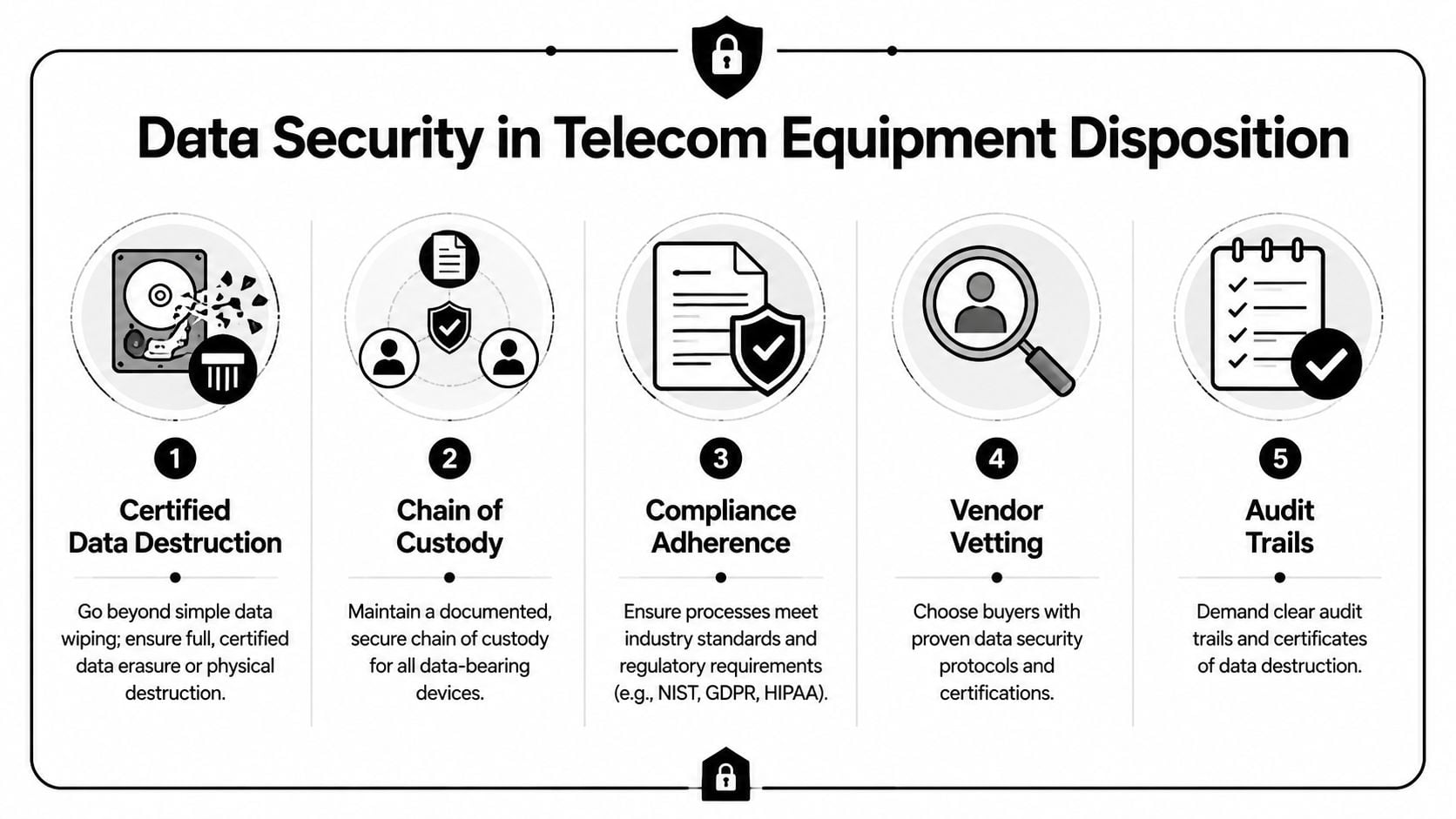
Wiping is a claim. Documentation is evidence.
Telecom gear can contain more than obvious user data. You may be dealing with call logs, voicemail storage, device configs, IP schemes, VPN parameters, certificates, admin credentials, or contact directories. Some devices have removable storage. Others store information in less obvious ways. That’s why a generic promise to “erase everything” isn’t enough.
You need to know:
- Which devices were identified as data-bearing
- What sanitization or destruction method was used
- How each serialized asset was tracked
- When liability transferred
- What certificate will be issued
For teams working through device categories and evidence requirements, this overview of data sanitization methods and documentation is a useful baseline.
What to require before assets leave the site
Your minimum documentation package should include a clear pickup record, serialized asset tracking where applicable, and a commitment to issue Certificates of Data Destruction and Certificates of Recycling if material is processed downstream.
If a buyer says they “can provide something if needed,” treat that as a warning. Enterprise disposition requires a standard output, not a favor on request.
Audit view: If your compliance officer can’t defend the record without calling the vendor for clarification, the record is weak.
Handle exceptions before pickup day
Not every device should follow the same path. If a system contains failed storage or damaged media, you may need physical destruction rather than logical sanitization. If a unit may contain evidence relevant to litigation, internal review comes before release. If equipment is locked, bricked, or partially dismantled, flag it early.
When a device’s data status is uncertain, consult internal security first. If recovery or preservation is part of the decision, outside data recovery experts can help determine whether media should be preserved, imaged, or destroyed before disposition moves forward.
The central point is simple. Price matters, but auditable proof matters more. Local buyers who can’t explain their records process are asking you to trust them where you should be verifying them.
Maximizing Financial Recovery and Negotiation
Most organizations leave money on the table in one of two ways. They accept the first quote because the closet needs to be cleared, or they send incomplete information and get priced like a scrap lot. Neither is necessary.
The strongest negotiating position is a documented asset package plus multiple vetted bids. According to bulk telecom valuation guidance, organizations should compare offers from multiple buyers to confirm fair pricing, and detailed inventory lists with brand, model, and functionality can create a 15-25% variance in final recovery value. The same guidance also notes that escrow or partial prepayment can reduce payment risk.

Understand which deal structure you’re being offered
Not every quote means the same thing. Ask whether the buyer is offering:
| Model | What it means | Best fit |
|---|---|---|
| Straight purchase | Buyer acquires the lot for an agreed amount | Clean, marketable inventory |
| Consignment or revenue share | Assets are sold later and proceeds are split | Higher-value gear with resale upside |
| Recycling offset or net fee | Commodity recovery offsets processing costs | Mixed or obsolete lots |
A straight purchase gives speed and certainty. Consignment can improve recovery on select equipment but usually requires more patience and tighter reporting. A recycling-heavy lot may still be the correct outcome if the gear is too old, damaged, or incomplete for remarketing.
Use the inventory to defend value
Negotiation should center on facts, not opinions. If your inventory shows tested units, complete accessories, and coherent model families, you can push back on broad discounts. If a buyer says the lot is risky, ask which items drive that view and request line-level commentary.
Useful pressure points include:
- Completeness of lots: phones with handsets and cords, chassis with modules, routers with power
- Known working pulls: recent de-installs are easier to remarket than long-abandoned storage finds
- Model concentration: large counts of the same model are easier for buyers to process
- Packaging readiness: staged, labeled inventory lowers labor on their side
A buyer who can’t explain pricing logic probably padded in uncertainty.
Don’t ignore payment terms
Recovery value is meaningless if collection risk is high. For larger transactions, escrow or partial payment before shipment can make sense, especially when the buyer is remote or the lot is substantial. Also ask when title transfers, when final reconciliation occurs, and how disputes are handled if counts differ from the manifest.
For businesses comparing resale and recycling paths, a structured telecom equipment liquidation program can help separate remarketable assets from true end-of-life material so the deal isn’t priced as one undifferentiated pile.
Executing Logistics and Finalizing the Transaction
Once pricing is agreed, the transaction becomes an operations exercise. Many otherwise solid deals often get sloppy during this phase. Equipment moves quickly, staff are busy, and details that seemed minor during quoting suddenly matter.
Pickup and shipping need different controls
On-site pickup is usually simpler for larger lots, branch consolidations, or heavy infrastructure. It reduces your packing burden and can speed chain-of-custody transfer. Shipping works for smaller lots or remote sites, but only if packaging, labeling, and manifest control are tight.
Whatever route you choose, align on these items before movement:
- Who packs the gear
- How pallets or cartons are labeled
- Whether serialized devices must be segregated
- What paperwork must be signed at departure
- Who carries transit risk
Match the paperwork to the physical load
Your bill of lading, pickup manifest, and internal asset list should tell the same story. If they don’t, reconciliation becomes painful later. For sensitive loads, sealed pallets and documented seal numbers are worth the extra effort because they strengthen your chain-of-custody record.
A clean closeout package usually includes:
- A signed pickup record or bill of lading
- The final asset reconciliation
- Confirmation of ownership transfer
- Final payment record
- Certificate of Data Destruction, if applicable
- Certificate of Recycling, if applicable
If the buyer wants to “send the certificates later,” define the timing in writing before pickup day.
Close the loop internally
Don’t stop when the truck leaves. Finance needs settlement records. Compliance needs certificates. IT needs confirmation that the lot is gone, reconciled, and removed from any remaining internal tracking list. If your organization has multiple sites, send the closeout package back to the originating stakeholders so everyone works from the same file set.
A telecom disposition project is finished only when the paperwork matches the physical outcome and every exception is resolved.
When you need a business-focused partner for secure telecom buyback, compliant recycling, and documented chain of custody, contact Beyond Surplus. Their services include telecom asset recovery, data destruction documentation, logistics coordination, and enterprise ITAD support for organizations that can’t afford gaps in valuation or compliance.